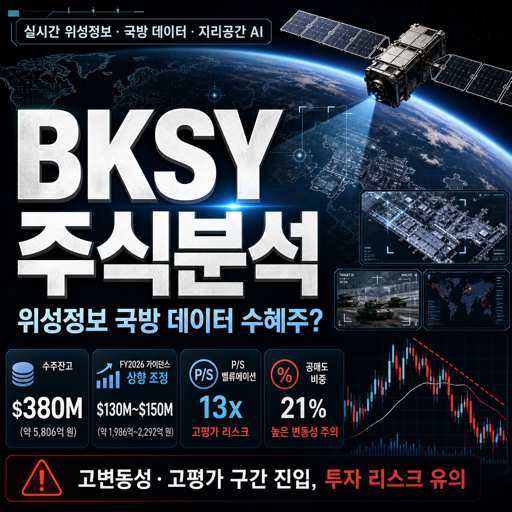
Black Sky Technology (BKSY) is a space intelligence company that supplies real-time satellite information to defense and intelligence agencies using the Gen-3 satellite constellation and the Spectra AI platform. The 12-month baseline target price is $41 (approx. 62,648 KRW) and the investment rating is Hold; the company is currently in a phase where upward guidance and the burden of high valuation coexist.
Analysis Date: 2026-06-12 · Applicable Exchange Rate: 1 USD = 1,528 KRW (As of 2026-06-11, applied equally to the entire post) · This article is an analysis for informational purposes only and is not an investment recommendation.
index
- Key Summary of Black Sky Stock Price Outlook
- What kind of company is Black Sky (BKSY)?
- Key Terms You Need to Know Before Analyzing Black Sky
- Black Sky Recent Q4 Earnings Analysis
- Black Sky Fair Value Analysis (Multiple · Scenario)
- Black Sky vs. Competitor Comparison
- Black Sky Growth Outlook and Key Drivers
- Black Sky 12-Month Target Price Scenario
- Black Sky Recent Major Issues
- Key Risks When Investing in Black Sky
- Black Sky Investment Opinion Conclusion
- 5 Frequently Asked Questions about Black Sky (BKSY)
- source
Key Summary of Black Sky Stock Price Outlook
Black Sky's 12-month baseline target price is $41 (approx. 62,648 won).
The investment opinion is Hold (Neutral).
The key basis is the upward revision of FY2026 revenue guidance ($130M~$150M) due to the full operation of Gen-3 satellites and the securing of a backlog of approximately $380M (approx. 580.6 billion KRW).
Based on the current share price of $35.97 (approx. 54,962 KRW), the weighted expected return is approximately +7.5%, indicating a phase with significant valuation and volatility burdens despite strong growth momentum.
The consensus of seven Wall Street analysts is Strong Buy, with an average target price of 1 TP/4 T/40.5 (approximately 61,884 won), which is similar to the baseline scenario of this analysis.
What kind of company is Black Sky (BKSY)?
Black Sky Technologies is a space-based intelligence company based in Herndon, Virginia, founded in 2014, and is listed on the NYSE.
The core business model is to sell real-time Earth observation information as a subscription service by combining high-resolution images captured by its own satellite constellation with the AI analysis platform 'Spectra'.
Revenue is largely composed of space-based intelligence and AI services (subscription-centric) and mission solutions such as satellite and payload production, with the U.S. federal government, intelligence agencies, and allied governments being major clients.
Competitors include major Earth observation operators such as Planet Labs (PL), Airbus and Maxar, Spire Global (SPIR), and Satellite Logic (SATL), while Black Sky differentiates itself through high-frequency revisiting, real-time monitoring, and defense-specialized positioning.
Key Terms You Need to Know Before Analyzing Black Sky
- Gen-3 satellite: Black Sky’s third-generation ultra-high-resolution (35cm class) observation satellite. It is characterized by rapid operationalization, entering commercial operation within hours of launch, and entered the full operational phase in the first quarter of 2026.
- Black Sky SpectraAn AI analysis software platform that integrates and processes data from the company's own satellites as well as third-party sensors such as SAR and RF. It is the core foundation of subscription revenue.
- Earth Observation (EO): An industry that photographs and analyzes the Earth's surface using satellites. Demand is highest in defense and intelligence, and it is expanding into insurance, agriculture, and logistics.
- Space Domain Awareness (SDA): The ability to track and monitor objects in orbit. This is a next-generation growth area for which Black Sky renewed a multi-year contract in June 2026.
- Backlog (order backlog): Amounts for which a contract has been signed but have not yet been recognized as revenue. It is an indicator showing the visibility of future revenue.
- P/S (Price-to-Sales Ratio): A multiple calculated by dividing market capitalization by revenue. It is primarily used to compare the valuations of loss-making growth stocks.
Black Sky Recent Q4 Earnings Analysis
Sales over the past four quarters showed a trend of significant quarterly fluctuations.
| branch | sales | Korean Won Conversion | Operating profit | Diluted EPS |
|---|---|---|---|---|
| Q2 2025 | $22.2M | Approximately 33.9 billion won | -$13.9M | -$1.27 |
| Q3 2025 | $19.6M | About 30 billion won | -$16.8M | -$0.44 |
| Q4 2025 | $35.2M | Approximately 53.8 billion won | -$4.2M | -$0.02 |
| Q1 2026 | $20.8M | Approximately 31.8 billion won | -$18.5M | -$0.82 |
Revenue for the first quarter of 2026 was $20.8M (approximately 31.8 billion KRW), a decrease compared to the same period of the previous year ($29.5M). This is largely due to the base effect, as revenue from mission solutions, such as satellite manufacturing, was concentrated in the previous quarter.
Revenue from core space-based intelligence and AI services grew 141 TP3T compared to the previous quarter, demonstrating the effect of Gen-3 operation.
During the first-quarter earnings announcement, the company disclosed securing new contracts worth up to 160 million USD (approximately 244.5 billion KRW), and the details are as follows Q1 earnings press release filed with the SECYou can check it at.
Based on TTM (last 12 months), revenue is $97.8M (approx. 149.4 billion KRW), and net loss is -$87.1M, indicating a continued deficit, while TTM EPS is -$2.49 (approx. -3,805 KRW).
Looking at the financial position, cash and short-term investments are approximately 1 TP4T115.5M (approx. 176.5 billion KRW) and total liabilities are 1 TP4T210.9M (approx. 322.3 billion KRW), resulting in a net debt structure, and the current ratio is 3.5 times, indicating good short-term liquidity.
Free cash flow (FCF) for the first quarter of 2026 was -$6.2M (approximately -9.5 billion won), with the deficit narrowing compared to the previous quarter, and funds were replenished through the issuance of $14M worth of shares during the quarter.
The detailed financial statements are 10-Q Report for Q1 2026It is disclosed in [it].
Black Sky Fair Value Analysis (Multiple · Scenario)
Since Black Sky has a negative FCF and the reliability of the traditional DCF is low, its fair value was assessed based on revenue multiples (EV/S·P/S).
| Valuation Assumptions | Usage value | reason |
|---|---|---|
| Evaluation method | EV/S Multiple (DCF Assist) | DCF alone is unsuitable due to a negative FCF. |
| FY2027 Projected Revenue | Approx. $175M | Applying +25% to the FY2026 median guidance of $140M |
| Applicable EV/S Drain | 6.5~11 times | Conservative compared to the current 14.6x, upper end of the Earth observation industry peers |
| Reflection of net debt | Approx. $95M | Total Liabilities $210.9M – Cash and Cash Equivalents $115.5M |
| Fair value range | $30~$46 | Presented as a range rather than a single value |
Currently, the TTM P/S is 13.6 times and the enterprise value EV/S is 14.6 times, which is the highest level in the Earth observation industry.
Based on the midpoint of the FY2026 guidance ($140M), the forward EV/S is lowered to approximately 10.2 times, but this figure is based on the assumption of achieving the guidance.
When comparing the fair value range $30~$46 with the current price $35.97 (approx. 54,962 won), the stock price is located in the lower middle of the range, so it is judged to be in the 'fair to slightly overvalued' range.
Black Sky vs. Competitor Comparison
| item | Black Sky (BKSY) | Planet Labs (PL) | Spire Global (SPIR) | Sattlelogic (SATL) |
|---|---|---|---|---|
| Market capitalization | $1.33B | Approximately $3B range (estimated) | n/a | n/a |
| TTM Sales | $97.8M | Approx. $270M+ (Estimated) | Approximately $110M (estimated) | n/a |
| Recent Quarterly Revenue Growth Rate (YoY) | -29.7% (base effect) | +42% | n/a | n/a |
| Profitability | Deficit (FY26 EBITDA Profit Guidance) | The deficit is narrowing | Deficit | Deficit |
| Key differentiators | High-frequency real-time observation + Defense AI subscription | World's largest constellation of observation satellites and data archives | RF and weather data specialized | Low-cost, high-resolution shooting |
In terms of sales volume and backlog stability Planet Labs (PL), No. 1 in Earth observation satellite datais superior.
On the other hand, Black Sky is ahead in technical differentiation, featuring real-time monitoring specialized for defense and intelligence agencies and Gen-3 ultra-high resolution.
Black Sky's valuation is the most expensive compared to peers, which is the market's price in the FY2026 +31% growth guidance.
Black Sky Growth Outlook and Key Drivers
FY2025 revenue was 106.6M (approx. 162.9 billion KRW), and the company raised its FY2026 guidance to 130M (approx. 198.6 billion KRW) to 150M (approx. 229.2 billion KRW).
The company stated that the median growth is approximately 311 TP3T year-over-year, and Gen-3-based subscription revenue is expected to increase by more than 501 TP3T.
The adjusted EBITDA guidance has also been raised to $12M (approx. 18.3 billion KRW) to $24M (approx. 36.7 billion KRW), bringing the company's first-ever annual EBITDA surplus within sight.
The growth rate estimate applied a weighted average of the past 3-year sales growth rate (approx. 81 TP3T, weight 0.4), FY2026 guidance and consensus (approx. 311 TP3T, weight 0.4), and the earth observation industry growth rate (approx. 151 TP3T, weight 0.2), resulting in an estimate of approximately 18.61 TP3T.
The key growth driver is the backlog, which amounts to $351M (approx. 536.3 billion KRW) as of the end of March and $380M (approx. 580.6 billion KRW) including large contracts in early April, of which $90M (approx. 137.5 billion KRW) is expected to be recognized as revenue this year.
In the satellite communications sector, a growth model based on stable government revenue Iridium (IRDM) Analysis on Long-term Investment Points in Satellite CommunicationsYou can also compare it in that.
Black Sky 12-Month Target Price Scenario
| scenario | Probability | Target price | Korean Won Conversion | Key assumptions |
|---|---|---|---|---|
| Bull | 25% | $52 | Approximately 79,456 won | FY27 Revenue $190M+, EV/S 11x, Upper end of guidance achieved |
| Base | 45% | $41 | Approximately 62,648 won | FY27 revenue approx. 1TP/4T/175M, EV/S 9x, median guidance |
| Bear | 30% | $24 | Approximately 36,672 won | Slowing Growth and Capital Dilution, EV/S Narrowed to 6.5x |
The scenario odds were set to base 451 TP3T, bullish 251 TP3T, and bearish 301 TP3T.
Although revenue visibility has improved due to upward guidance and backlog expansion, the turnaround to EBITDA has not yet been verified, and reflecting the high valuation of 13x P/S, short selling volume of 21% relative to free float, and extreme volatility of beta 2.5, the probability of a bear has been raised from the base 25% to 30%.
The weighted expected price is 1 TP4T39.0 (approx. 59,592 won), which is about +7.51 TP3T compared to the current price, and this corresponds to the Hold zone (expected return 0~151 TP3T).
Black Sky Recent Major Issues
In the first-quarter results announced on May 7, 2026, the company raised its annual revenue and EBITDA guidance, and detailed management comments are Full text of the Q1 earnings conference callYou can check it at.
The fourth Gen-3 satellite transmitted ultra-high-resolution images within hours of launch and entered commercial operation within a week, bringing the Gen-3 system into full operational phase.
In June 2026, the company announced a multi-year contract renewal focused on non-Earth imagery and Space Domain Awareness (SDA) capabilities, securing a new growth axis of AI-based orbital surveillance.
The stock price surged by about 1,781 TP3T over the course of a year, recording a 52-week high of 52.88 (about 80,801 won) at the end of May, then underwent a correction of about 281 TP3T for one week in early June amid profit-taking across the entire stock market, and rebounded by 131 TP3T on June 11, closing at 35.97 (about 54,962 won).
Key Risks When Investing in Black Sky
First is the profitability risk. As the company remains in a state of net loss and negative FCF on an annual basis, failure to meet the guidance for a positive EBITDA could lead to dilution of shareholder value due to an additional capital increase. Quarterly adjusted EBITDA and trends in the number of shares must be monitored.
Second is the risk of customer concentration. Since the majority of revenue comes from contracts with the U.S. government and allied governments, the structure is such that revenue recognition is delayed if the defense budget is delayed or cut. It is necessary to track the schedule for the passage of government fiscal year budgets and the disclosure of new orders.
Third, there are valuation and supply and demand risks. A P/S ratio of 13x already reflects growth expectations to a significant extent, while the outstanding short selling volume of 211 TP 3 T and a beta of 2.5 amplify sharp fluctuations. Caution should be exercised regarding increased volatility before and after earnings announcements.
Similar high-volatility space sector cases are Analysis of Redwire (RDW), a growth stock in the space industryIt has been covered in...
Black Sky Investment Opinion Conclusion
The investment opinion on Black Sky is Hold (Neutral), the confidence level is Medium, and the investment period is based on 12 months.
While fundamental improvements such as full Gen-3 operation, upward guidance, and a $380M backlog are evident, they are already largely reflected in the stock price, which has risen 1,78% over the past year.
For new entries, a staggered approach during corrections is reasonable, and it is advisable to limit positions to a small portion of the portfolio in light of high volatility.
We examined both the valuation burden and the potential for a rebound within the satellite sector. VSAT Analysis of the Satellite Internet Competitive LandscapeIt is also worth referring to.
5 Frequently Asked Questions about Black Sky (BKSY)
Q1. What is the 12-month target price for Black Sky (BKSY)?
Based on the base scenario, the level is $41 (approx. 62,648 KRW), suggesting a bullish range of $52 (approx. 79,456 KRW) and a bearish range of $24 (approx. 36,672 KRW). The weighted expected return is approximately +7.5%, placing it in the Hold zone.
Q2. Why is Black Sky classified as a beneficiary of the defense and satellite information sectors?
The key reasons are the Gen-3 satellite's 35cm-class ultra-high-resolution real-time observation, multi-year subscription contracts with the U.S. government and allies, and the expansion of the Space Domain Awareness (SDA) contract. Increased demand for information due to geopolitical tensions is a structural tailwind.
Q3. Is Black Sky's current stock price overvalued or undervalued?
With a TTM P/S of 13.6x, it is at the highest level in the earth observation industry and is located in the lower-middle range of the fair value range of $30 to $46. It is judged to be fair if guidance is achieved, and overvalued if it is not.
Q4. Which is more attractive to invest in, Black Sky or Planet Labs?
Planet Labs (PL) holds the advantage in terms of revenue scale, contract stability, and valuation burden, while Black Sky leads in short-term growth guidance and a defense-specialized position. PL is suitable for those who prioritize stability, while BKSY is suitable for those who prefer high risk and high growth.
Q5. What is the biggest risk when investing in Black Sky?
The top three risks are persistent deficits, the possibility of capital dilution, dependence on the government budget, and extreme volatility with a short selling balance of 211 TP3T and a beta of 2.5. Quarterly EBITDA and new order disclosures are key monitoring indicators.
source
- BlackSky Q1 2026 Form 10-Q (SEC EDGAR)
- BlackSky Q1 2026 Earnings Press Release (SEC 8-K)
- BlackSky Q1 2026 Earnings Call Transcript (The Motley Fool)
- BlackSky FY2026 Guidance Report (Seeking Alpha)
This article is an analysis for informational purposes only and does not constitute a recommendation to buy or sell any specific stock. Investment decisions and responsibilities rest solely with the investor.
※ This analysis utilized AI tools during the writing process, and the final content has been verified by the author. It is for informational purposes only, and investment decisions and responsibilities lie solely with the investor.