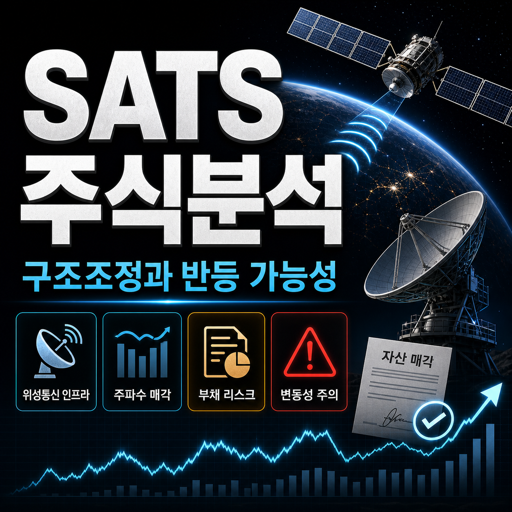
Echostar (SATS) transformed from a telecommunications infrastructure company into a story of asset revaluation by selling a $40 billion spectrum to AT&T and SpaceX. The 12-month baseline target price is $138 (approx. 208,932 KRW), and the investment rating is Hold. Massive debt and the value of the SpaceX stake are key variables determining the stock price.
Analysis Date: 2026-06-15 · Applied Exchange Rate: 1 USD = 1,514 KRW (All KRW conversions in this article were calculated using this exchange rate) · This article is an analysis for informational purposes only and is not an investment recommendation.
index
- Key Summary of EcoStar SATS Stock Price Outlook
- What kind of company is EcoStar (SATS)?
- Key Terms You Need to Know Before Analyzing EcoStar
- Ecostar Recent Quarterly Performance Analysis
- Echostar frequency sale and SpaceX stake
- Ecostar Fair Stock Price Analysis (Asset Value · Multiple)
- Ecostar 12-Month Target Price Scenario
- Ecostar Recent Major Issues
- Ecostar vs. Satellite Communication Competitors Comparison
- Key Risks When Investing in Ecostar
- Ecostar Investment Opinion Conclusion
- 5 Frequently Asked Questions about EcoStar SATS
Key Summary of EcoStar SATS Stock Price Outlook
The 12-month baseline target price for EcoStar (SATS) is $138 (approximately 208,932 won).
The investment recommendation is Hold.
The key basis is the asset value of the $40 billion spectrum sale proceeds and SpaceX stake, and the debt burden of approximately 44 trillion won that offsets this.
EchoStar is a U.S. telecommunications holding company that owns satellite broadcasting (DISH), satellite communications (Hughes), and wireless communications (Boost Mobile).
With an agreement to sell its spectrum holdings to AT&T and SpaceX on a large scale starting in the second half of 2025, the market’s view has shifted from a loss-making telecommunications business to an asset-revalued stock holding massive cash and SpaceX shares.
The stock price has surged approximately 3,831 over the past year, skyrocketing from a 52-week low of 23.97 (approx. 36,290 won) to a high of 147.25 (approx. 222,937 won), and the current price is at 117.87 (approx. 178,455 won).
What kind of company is EcoStar (SATS)?
EcoStar Corporation is a telecommunications holding company based in Englewood, Colorado, USA, founded by Charlie Ergen in 1980.
The business is broadly divided into three branches: the Pay-TV division (DISH and Sling), which handles satellite broadcasting and OTT streaming; the wireless communications division (Boost Mobile and Gen Mobile); and the Broadband & Satellite Services division (Hughes and Hughesnet), which manages satellite broadband and communications for government and enterprise.
In addition, the Other division responsible for building 5G networks is added. The number of employees is approximately 12,100, and TTM revenue is approximately 22.4113 trillion won (approx. 1.41148 billion).
Founder Ergen still controls the company as Chairman and CEO, with insider ownership amounting to approximately 13.81 TP3T. While the telecommunications business itself has suffered from declining subscribers and deficits, the core of the investment story lies in the fact that the wireless frequency licenses the company has accumulated over decades have belatedly begun to be recognized for their immense value.
Key Terms You Need to Know Before Analyzing EcoStar
- Frequency (Spectrum) — The right to use radio frequency bands used for wireless communication. It is allocated by the government as a license and is a core asset for 5G and satellite communication. It is the biggest variable determining EcoStar's corporate value.
- MVNO (Virtual Mobile Network Operator) — A business operator that provides telecommunications services by borrowing a third party's network without having its own network. Echo Star maintains Boost Mobile by entering into a hybrid MVNO contract with AT&T.
- going concern — An accounting assumption that a company can continue its business in the future. EcoStar once questioned this assumption due to concerns over debt repayment.
- SOTP (Sum-Of-The-Parts) — A valuation technique that evaluates business units and assets separately and aggregates them. It is suitable for EcoStar, which possesses heterogeneous assets such as frequencies and a stake in SpaceX.
- EBITDA — Earnings before interest, taxes, and depreciation. It is an indicator used to gauge the cash generation capacity of industries with high depreciation, such as telecommunications.
Ecostar Recent Quarterly Performance Analysis
Ecostar announced its earnings for the first quarter of fiscal year 2026 (ending March 31, 2026) on May 10, 2026.
First-quarter revenue was approximately 5.5526 trillion won ($3,667.5M), a decrease of 5.2% compared to approximately 5.8588 trillion won ($3,869.8M) in the same period last year. This reflects a structural revenue slowdown resulting from the continued churn of Pay-TV subscribers.
Net loss was approximately 222.4 billion won (146.9M), and earnings per share (EPS) was -0.51 (approx. -772 won), exceeding market expectations of -0.62 by approximately 181.3T. A sharp decline in depreciation expenses and the reversal of one-time impairment losses narrowed the deficit.
It is worth noting that operating profit turned into a surplus of approximately 392.7 billion won ($392.8M). Quarterly report filed with the SEC (10-Q)According to [source], the company recorded going concern and large impairment losses in previous quarters, but profitability in the operating phase improved in the first quarter.
However, the TTM EPS is -$50.21 (approx. -76,018 won), representing an extreme deficit. This is the result of reflecting a massive non-cash impairment loss of approximately $16.5 billion recognized in the third quarter of 2025, and is not a loss from the operation itself but a product of accounting asset revaluation.
| item | Figure (USD) | Korean Won Conversion |
|---|---|---|
| Q1 sales | $3,667.5M | Approximately 5.5526 trillion won |
| Sales in the same period last year | $3,869.8M | Approximately 5.8588 trillion won |
| Q1 net loss | -$146.9M | Approximately -222.4 billion won |
| Q1 EPS | -$0.51 | Approximately -772 won |
| TTM Sales | $14,802.7M | Approximately 22 trillion 411.3 billion won |
| Total debt | $29.24B | Approximately 44 trillion 269.4 billion won |
| Total cash | $1.52B | Approximately 2.2952 trillion won |
Echostar frequency sale and SpaceX stake
The core of the EcoStar investment story is not telecommunications operations, but the sale of its owned frequencies.
The company agreed to sell frequency licenses worth approximately 34.2921 trillion won ($22.65B) to AT&T and to transfer frequencies worth approximately 30.28 trillion won ($20B) to SpaceX. The two deals combined exceed $40 billion.
The deal began in earnest in 2026 as the FCC (Federal Communications Commission) approved the sale, and the transfer of frequencies to SpaceX was completed on May 22, 2026.
In particular, the SpaceX deal involves not only cash but also approximately 2.21 TP3T of SpaceX equity in exchange. For this reason, EcoStar has emerged as virtually the only listed proxy available to invest in the privately held SpaceX.
As SpaceX embarks on a historic IPO in June 2026, EcoStar's stock price fluctuated in line with the value of this stake. One brokerage firm (New Street) analyzed that the current stock price reflects the value of the SpaceX stake at only about 1 TP4T86 per share, suggesting there is room for undervaluation.
However, as the timing of the inflow of proceeds from the sale of AT&T coincides with the pressure to repay DISH DBS debt, whether cash flows in on time is becoming a critical turning point for the short-term stock price.
Ecostar Fair Stock Price Analysis (Asset Value · Multiple)
Since EcoStar is a loss-making company, a PER-based valuation is meaningless. Therefore, a Sum of the Parts (SOTP) perspective is more appropriate.
The current market capitalization is approximately 51.7165 trillion won ($34.16B), and the enterprise value (EV) is approximately $61.9B. The price-to-sales ratio (P/S) is about 2.3 times, which is not a burdensome level for a telecommunications holding company.
The key is how much the proceeds from the sale of frequencies exceeding $40 billion and the value of the SpaceX stake (approx. 2.21 TP3T) will offset the total debt amounting to approximately 44.2694 trillion won (1 TP4T29.24B).
Book value per share (BPS) is 19.47 (approximately 29,471 won), but this is merely the book value after impairment losses and does not fully reflect the market value of the frequency. If the proceeds from the sale are converted into cash and liabilities are reduced, the asset value could significantly exceed the book value.
The average target price of five Wall Street analysts is $137.6 (approx. 208,326 won), the median is $131 (approx. 198,334 won), and the range is from a high of $161 to a low of $120. TD Cowen raised its target price from $129 to $155 following first-quarter earnings.
Ecostar 12-Month Target Price Scenario
Based on the current price of $117.87 (approx. 178,455 won), we present three scenarios for the 12-month target price.
| scenario | Target Price (USD) | Korean Won Conversion | Expected rate of return |
|---|---|---|---|
| Bull | $165 | Approximately 249,810 won | Approx. +40% |
| Base | $138 | Approximately 208,932 won | Approx. +17% |
| Bear | $95 | Approximately 143,830 won | Approx. -19% |
The bullish scenario assumes that proceeds from the frequency sale flow in without disruption and the value of the SpaceX stake rises further following the IPO. Debt is rapidly reduced, and asset revaluation begins in earnest.
The base scenario approaches the analyst average and assumes a equilibrium phase where the sale proceeds as scheduled but the slowdown in revenue from the core telecommunications business continues.
The bearish scenario occurs when AT&T payment inflows, DISH DBS debt repayment difficulties, and a SpaceX equity valuation adjustment overlap. The weighted expected return, calculated by applying weights of 301 TP3T, 451 TP3T, and 251 TP3T to the bullish, basic, and bearish scenarios respectively, is approximately +151 TP3T, which aligns with the Hold zone.
Ecostar Recent Major Issues
SpaceX's IPO in June 2026 has emerged as the biggest event for the entire satellite stock market.
As SpaceX traded above its IPO price on its first day of listing, EcoStar's volatility increased as it acted as a SpaceX proxy. On some trading days, the stock price fell by approximately 71 TP3T due to profit-taking in proxy trades. Related market trends are Motley Fool's June 12 Market ReportIt was covered in detail in [location].
Meanwhile, there is also analysis suggesting that expectations for frequency sales across the satellite industry are driving up stock prices. Barron's special feature on satellite frequenciesIt was pointed out that while EcoStar, ViaSat, and Iridium surged due to a revaluation of their frequency holdings, the burden of verification increases over time.
Ecostar vs. Satellite Communication Competitors Comparison
The satellite communications and frequency revaluation theme stocks grouped with EcoStar share similar volatility and narratives.
The most direct comparison is with competitors in the satellite internet business. Satellite Internet competitor VSATViaSat is also a highly volatile stock that has surged over the past year due to a record order backlog and a revaluation of frequency value.
If you want stable cash flow Stable satellite communications company Iridium (IRDM)This is the alternative. It has higher business stability than EcoStar due to steady revenue from IoT and government services based on the 66 LEO satellite network.
Attracting attention due to expectations of collaboration with Apple Global Star (GSAT) in satellite communicationsThis is a case where the value of frequency assets has been highlighted. In the field of satellite data and information... Real-time satellite information company Black Sky (BKSY)is the subject of comparison.
Key Risks When Investing in Ecostar
- massive debt With total debt of approximately 44.2694 trillion won ($29.24B), a debt-to-equity ratio of 515%, and a current ratio of 0.30, there is significant pressure on short-term liquidity.
- Timing of inflow of sale proceeds If AT&T and SpaceX payments are not received on time, it will cause difficulties in repaying the DISH DBS debt.
- Changes in SpaceX equity value — The stock price effectively moves as a proxy for SpaceX, so there is a risk of a simultaneous decline when SpaceX's valuation is adjusted.
- Slowdown in core business sales Revenue is structurally declining due to the churn of Pay-TV subscribers.
- High short selling volume — The short selling ratio relative to outstanding shares is very high at approximately 361 TP3T, resulting in extreme volatility.
Ecostar Investment Opinion Conclusion
The investment recommendation for EcoStar (SATS) is Hold.
The strong asset value of the spectrum sale proceeds exceeding $40 billion and the SpaceX stake is a clear driving force for growth. The turnaround to a profit in operating income in the first quarter is also a signal of fundamental improvement in the core business.
On the other hand, debt in the 44 trillion won range, uncertainty regarding the timing of the sale proceeds inflow, and extreme volatility as a SpaceX proxy act as counterweights. The fact that expectations for asset revaluation have already been largely reflected in the stock price due to the surge of 3,831 TP3T over the past year is also a basis for caution.
Until the monetization of sale proceeds and debt reduction are confirmed in the actual financial statements, a staggered approach and a wait-and-see strategy are more reasonable than chasing the rally. Analyst opinions are also evenly divided, with 3 buy and 3 neutral.
5 Frequently Asked Questions about EcoStar SATS
Q1. What is the 12-month target price for EcoStar (SATS)?
Based on the base scenario, the level is $138 (approx. 208,932 KRW), suggesting a bullish range of $165 (approx. 249,810 KRW) and a bearish range of $95 (approx. 143,830 KRW). The weighted expected return is approximately +15%, placing it in the Hold zone.
Q2. Why is EcoStar referred to as a SpaceX-related stock?
EcoStar agreed to receive approximately 2.21 TP3 T in SpaceX shares in exchange for selling its frequencies to SpaceX. This is because it emerged as virtually the only listed proxy for indirect investment in the privately held SpaceX.
Q3. What is the scale of EcoStar's frequency sale?
The deal involves approximately 34.2921 trillion KRW ($22.65B) for AT&T and 30.28 trillion KRW ($20B) for SpaceX, totaling over $40 billion. Following FCC approval, the transaction began in earnest in 2026.
Q4. What is the biggest risk of investing in EcoStar?
It faces liquidity pressure and total debt amounting to approximately 44.2694 trillion won. If the sale proceeds are not received on time, it could disrupt the repayment of DISH DBS debt and be significantly affected by fluctuations in the value of SpaceX shares.
Q5. Should I buy EcoStar stock now?
The investment recommendation is Hold. While asset value is attractive, expectations have largely been priced in due to the sharp rise of 3,831 TP3T over the past year, and there are significant risks regarding debt and volatility. Until the cashing out of the sale proceeds and debt reduction are confirmed in the financial statements, a spin-off approach and a wait-and-see strategy are reasonable.
This article is an analysis for informational purposes only and not an investment recommendation; all investment decisions and responsibilities rest solely with the investor. Analysis date: June 15, 2026, applicable exchange rate: 1 USD = 1,514 KRW.
※ This analysis utilized AI tools during the writing process, and the final content has been verified by the author. It is for informational purposes only, and investment decisions and responsibilities lie solely with the investor.