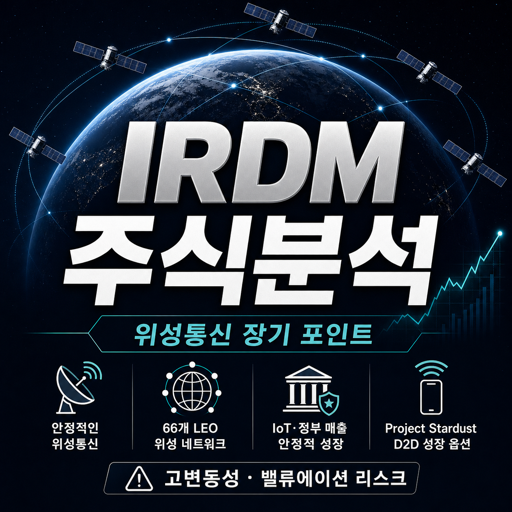
Iridium (IRDM) is the only global satellite communications operator that seamlessly covers the world with a network of 66 Low Earth Orbit (LEO) satellites. While it possesses stable IoT and government revenue alongside growth options from Project Stardust Direct-to-Digital (D2D), its current price has entered a high-valuation zone, surpassing the average analyst target price following a surge of 1,931 TP3T since the beginning of the year.
Analysis Date: 2026-06-10 · Applied Exchange Rate: 1 USD = 1,520 KRW (All KRW conversions in this article were calculated using this exchange rate) · This article is an analysis for informational purposes only and is not an investment recommendation.
index
- Key Summary of Iridium IRDM Stock Price Outlook
- What kind of company is Iridium (IRDM)?
- Key Terms to Know Before Iridium Analysis
- Iridium Recent Q4 Earnings Analysis
- Iridium Fair Value Analysis (DCF/Multiple)
- Iridium vs. Competitor Comparison
- Iridium Growth Prospects and Key Drivers
- Iridium 12-Month Target Price Scenario
- Iridium Recent Major Issues
- Key Risks When Investing in Iridium
- Iridium Investment Opinion Conclusion
- 5 Frequently Asked Questions about Iridium IRDM
Key Summary of Iridium IRDM Stock Price Outlook
Iridium's 12-month baseline target price is $45 (approx. 68,400 won).
The investment recommendation is Hold.
The key rationale is the stable cash flow based on the 66-unit LEO satellite network and the Project Stardust D2D option, but the valuation has outpaced the fundamentals due to a surge of 1931 TP3T since the beginning of the year.
The current price is $45.10 (approx. 68,552 won), and the market capitalization is $4.768B (approx. 7.2474 trillion won). It fell by about 5% in one day due to concerns over prolonged interest rates following the release of strong May employment figures on June 5, 2026.
- Investment Point 1: With 2.555 million believable subscribers (+51 TP 3T YoY) and 2.02 million commercial IoT subscribers (+71 TP 3T YoY), the subscription revenue base is solid.
- Investment Point 2: Government revenue visibility is high due to the 7-year EMSS contract with the U.S. Department of Defense worth 1.7385 million USD (approx. 1.1225 trillion KRW).
- Investment Point 3: Project Stardust (NB-IoT NTN) direct connection service is scheduled for commercialization in 2026, providing a new growth option.
What kind of company is Iridium (IRDM)?
Iridium Communications Inc. is a satellite communications company headquartered in McClain, Virginia, USA, that launched its satellite network in 1998.
As the only operator covering the entire Earth (including the polar regions) with 66 L-band LEO satellites, it provides voice, data, IoT, and satellite time positioning (PNT) services.
Revenue is broadly divided into service revenue (commercial, government, and IoT) and equipment and engineering revenue. It is a subscription-based structure where service revenue accounts for approximately 721 TP3T of the total.
The core business segments are commercial voice and data, commercial IoT, government services (EMSS), equipment sales, and a stake in the aircraft tracking joint venture Aireon.
The business model is subscription-based through a wholesale distribution network (service provider and value-added reseller), and after building the satellite network once, it has a high-margin structure with low marginal cost per subscriber (gross margin 71.61 TP3T).
In the competitive landscape, the direct connection services of GlobalStar (GSAT), ViaSat (VSAT), AST Space Mobile (ASTS), and Starlink are emerging as major competitive and substitution threats.
Key Terms to Know Before Iridium Analysis
- D2D (Direct-to-Device)A technology that enables satellites to communicate directly with standard smartphones, wearables, and automobiles without the need for separate terminals. It is Iridium's next-generation growth engine.
- NB-IoT NTN (Narrowband IoT Non-Terrestrial Network): A narrowband IoT non-terrestrial network based on the 3GPP 5G standard. It is a standard adopted by Project Stardust.
- PNT (Positioning, Navigation, Timing): Positioning, navigation, and time synchronization services. It serves as a backup in the event of GPS jamming or failure, and there is high demand from the government and defense sectors.
- OEBITDA (Operational EBITDA): Operating EBITDA, presented by Iridium as a key profitability indicator. It is the benchmark for the 2026 guidance.
- EMSS (Enhanced Mobile Satellite Services): A fixed-price government contract through the U.S. Department of Defense's dedicated gateway. It is currently worth 1738.5 million USD (approximately 1.1225 trillion KRW) over 7 years.
Iridium Recent Q4 Earnings Analysis
Revenue for the last four quarters (TTM) is $875.8M (approximately 1.3312 trillion won), and quarterly revenue is trading steadily in the $210M range.
| branch | Sales (USD M) | Diluted EPS | Net Profit (USD M) |
|---|---|---|---|
| Q1 2025 | $214.9M | $0.27 | $30.4M |
| Q2 2025 | $216.9M | $0.20 | $22.0M |
| Q3 2025 | $226.9M | $0.35 | $37.1M |
| Q4 2025 | $212.9M | $0.24 | $24.9M |
| Q1 2026 | $219.1M | $0.20 | $21.6M |
Q1 2026 earnings were in line with the consensus with revenue of $219.1M (approx. 333 billion KRW, +2% YoY).
Service revenue was 158.0M (approx. 240.2 billion KRW, +213T YoY), and equipment and engineering revenue was 61.0M (approx. 92.7 billion KRW).
Government service revenue recorded $27.6M (approx. 42 billion KRW, +3% YoY), driven by unit price increases for EMSS contracts. Specific quarterly performance figures are Iridium Q1 Earnings AnnouncementYou can check it at.
However, net profit was 1.16 million (approx. 32.8 billion KRW), a decrease of approximately 291 million compared to 30.4 million in the same period last year. The main reason was increased costs resulting from changes in the incentive compensation system.
Financial soundness is generally good. With a current ratio of 2.85 times and a quick ratio of 1.99 times, there are no issues with short-term solvency.
However, total debt resulting from the construction of the satellite network amounts to 1,789 million (approximately 2.7193 trillion won), with a debt-to-equity (D/E) ratio of 3,821 million, indicating high leverage relative to capital.
Free cash flow (FCF) is 1 TP4 T253 M (approximately 384.6 billion KRW) on a TTM basis, generating an FCF yield of approximately 5.31 TP3 T relative to market capitalization and serving as a source for dividends and share buybacks.
Iridium Fair Value Analysis (DCF/Multiple)
Current valuations are trailing P/E 45.6x, forward P/E 32.6x, P/S 5.44x, P/B 10.2x, and EV/EBITDA 14.7x.
While an EV/EBITDA multiple of 14.7x is not excessive considering the proprietary satellite network assets, a trailing P/E multiple of 45.6x is a burdensome multiple given the low growth of 2%.
The following are the DCF assumptions used to calculate the fair value.
| DCF assumption items | Usage value | reason |
|---|---|---|
| Discount rate (WACC) | 9.5% | Beta 0.89 · Reflects high debt capital structure |
| End-of-life value growth rate (g) | 2.5% | Long-term GDP + Inflation |
| forecast period | 5 years | Satellite network replacement cycle visibility |
| Base FCF | $253M | Previous TTM FCF |
| Bull FCF | $329M (×1.3) | D2D subscribers make a full contribution |
| Bear FCF | $202M (×0.8) | Intensified competition and increased interest costs |
The fair value range per share calculated based on this assumption is approximately $36 to $48 (approximately 54,720 won to 72,960 won).
The current price of $45.10 is at the upper end of this fair value range. As it already exceeds the analyst average target price of $37.875 (approximately 57,570 won), the valuation assessment is 'perfect value to slightly overvalued'. Valuation Debate Following Oppenheimer's Investment UpgradeIt also addresses this point as a key issue.
Iridium vs. Competitor Comparison
Compared to major stocks in the satellite communications sector, Iridium is differentiated by stability, including profitability, high margins, and dividends. The figures below are approximations based on market data.
| item | Iridium (IRDM) | Global Star (GSAT) | VSAT | AST(ASTS) |
|---|---|---|---|---|
| Market capitalization | Approx. $4.8B | Approx. $3.5B | Approx. $3B | Approx. $15B |
| TTM Sales (USD M) | $876M | Approx. $250M | Approximately $4,500M | almost none |
| Sales Growth Rate (YoY) | +2% | High (Apple) | single digit | Before commercialization |
| Operating Margin | 23.2% | Low/Defense | Deficit | Deficit |
| Forward P/E | 32.6 times | n/a | n/a (deficit) | n/a |
| Key differentiators | 66th LEO Global Surplus Business | Apple Satellite SOS | Broadband and high debt | Direct smartphone connection |
Iridium is the only competitor that maintains a stable profit and dividends. Although its sales growth rate is the lowest, it holds an overwhelming advantage in profitability and cash flow visibility.
On the other hand, in terms of growth potential, Globalstar, which has partnered with Apple, and AST Space Mobile, which is aiming for direct smartphone connectivity, present a more aggressive upside.
Iridium Growth Prospects and Key Drivers
The company reaffirmed its full guidance for 2026 with service revenue flat to +21 TP3T and OEBITDA 1 TP4T480 to 490M (approximately 729.6 billion to 744.8 billion KRW).
The growth drivers are an increase in commercial IoT subscribers, unit price hikes for EMSS government contracts, and new D2D revenue based on Project Stardust. The background of management's guidance is Full Transcript of Q1 2026 Earnings Conference CallYou can check the details at.
The growth rate estimate was calculated as a weighted expected growth rate of approximately 6.21 TP3T by combining the historical sales CAGR of approximately 51 TP3T (weighted 401 TP3T), the analyst consensus of approximately 31 TP3T (weighted 401 TP3T), and the satellite IoT and D2D industry growth rate of approximately 151 TP3T (weighted 201 TP3T).
In the long term, if D2D standardization (3GPP) is fully adopted, there is potential for the subscriber base to expand from millions to tens of millions. However, this is an option value that will become visible after 2027.
Iridium 12-Month Target Price Scenario
The target price under the base scenario (probability 501 TP3T) is 1 TP4T45 (approx. 68,400 won). This value is calculated by applying a forward P/E of approximately 32 times, reflecting the satellite franchise premium, to the forward EPS of 1 TP4T1.38 (approx. 2,098 won), which effectively implies sideways movement at the current price level.
The target price for the bullish scenario (probability 20%) is $60 (approx. 91,200 won). This is the case where the commercialization of Project Stardust D2D yields early results and Oppenheimer's $60 target price is realized.
The target price for the bearish scenario (probability 30%) is $30 (approximately 45,600 won). This is the case where momentum is reversed after a sharp rise of 193% and the multiple contracts to its historical average.
The reason for setting the scenario weights at 50/20/30 is that while stable cash flow provides some downside support, it is reasonable to set the probability of a bearish trend higher than a bullish one, given that the current price exceeds the analyst average target price and the short-term surge was significant.
The weighted expected return is approximately -3.61 TP3T, indicating limited meaningful upside potential based on the current price.
Iridium Recent Major Issues
In early June 2026, Oppenheimer maintained its Outperform rating and raised its target price from $48 to $60, highlighting investment interest in the satellite connectivity theme.
The stock price surged 1,931 TP3T since the beginning of the year and rose approximately 331 TP3T in the past month, standing at the center of the satellite stock rally.
However, following the release of strong May employment figures on June 5, the market corrected by approximately 51 TP3 T in a single day due to concerns over prolonged interest rates. It is a phase where volatility has increased across the entire space and satellite sector.
The same space and satellite theme flow Planet Labs (PL), a beneficiary of satellite image and Earth observation data와 Redwire (RDW), a growth stock in the space industryIt is also commonly observed in [other places].
Key Risks When Investing in Iridium
Risk 1 — Overvaluation: Current price exceeds analyst average target price → Double-digit correction possible upon momentum retracement → Monitoring indicators are the 50-day moving average ($40.8) and volume trends.
Risk 2 — Low-growth structure: Service revenue +2% low growth → Derating if high multiples are not justified → Monitoring metrics are quarterly net subscriber growth and ARPU.
Risk 3 — Intensified D2D competition: Entry of Starlink, AST, and Globalstar into direct connections → Pressure on price and market share → Monitoring indicators are the speed of MNO partnership signing and the commercialization schedule of Stardust.
Risk 4 — High Debt and Interest Rates: Debt $1,789M (approx. 2.7193 trillion KRW), D/E 382% → Interest expense burden if interest rates are prolonged → Monitoring indicators are net interest expense and refinancing schedule.
Risk mitigation factors include revenue visibility from the 7-year EMSS government contract, a high gross margin of 71.61 TP3T, and stable annual FCF of 1 TP4T253M (approximately 384.6 billion KRW). To compare the volatility of the space and satellite sector Intuitive Machines (LUNR), a beneficiary of lunar exploration commercializationIt is also worth noting cases of high variability.
Iridium Investment Opinion Conclusion
The investment recommendation is Hold. The confidence level is Medium, and the investment period is based on 12 months.
Iridium is an exclusive satellite network asset featuring profitability, high margins, and dividends, making it clearly attractive for long-term holding. However, given that the current price has exceeded the upper end of its fair value and the average analyst target price due to a short-term surge, it is reasonable to consider staggered buying during corrections for new entries.
Existing holders should maintain their holdings as long as core fundamentals remain intact, but a strategy of using the progress of D2D commercialization and net subscriber growth as monitoring indicators is appropriate.
5 Frequently Asked Questions about Iridium IRDM
Q1. What is the 12-month target price for Iridium (IRDM)?
Based on the base scenario, the level is $45 (approx. 68,400 won), suggesting a bullish range of $60 (approx. 91,200 won) and a bearish range of $30 (approx. 45,600 won). The weighted expected return is approximately -3.6%, placing it in the Hold zone.
Q2. Why is Iridium classified as a beneficiary of satellite communications?
This is because it is the only operator covering the entire globe, including the polar regions, with 66 LEO satellites. It has stable revenue from commercial IoT and government EMSS subscriptions, and is also entering the direct smartphone connection market with Project Stardust D2D.
Q3. Is Iridium's current stock price overvalued or undervalued?
It is at full value to slightly overvalued. Trailing P/E is 45.6x and EV/EBITDA is 14.7x, and the current price of $45.10 is located at the upper end of the DCF fair value range of $36–$48 (approximately 54,720 KRW–72,960 KRW). It has also already exceeded the average analyst target price ($37.875).
Q4. Which is more attractive as an investment, Iridium or GlobalStar (GSAT)?
If you prioritize stability, Iridium is the choice. It is profitable, has high margins and dividends, and offers high revenue visibility. On the other hand, if you prefer high growth and volatility, Globalstar, which collaborates with Apple, has greater upside potential but is inferior in profitability.
Q5. What is the biggest risk when investing in Iridium?
It is characterized by overheated valuation and a low-growth structure. The current price has surpassed the average target price due to a surge of 1,931 TP3T since the beginning of the year, while service revenue growth is limited to +21 TP3T. Monitoring indicators include the 50-day moving average, quarterly net subscriber growth, and the D2D commercialization schedule.
Sources
- Iridium Q1 2026 Earnings Announcement (StockTitan)
- Iridium Q1 2026 Earnings Call Transcript (Motley Fool)
- Iridium Valuation After Oppenheimer Upgrade (Yahoo Finance)
This article is not an investment recommendation and is an analysis for informational purposes only. Investment decisions and responsibilities rest solely with the investor.
※ This content is based on publicly available data, written with the help of AI tools, and reviewed by the author. It is for informational purposes only and is not an investment recommendation.