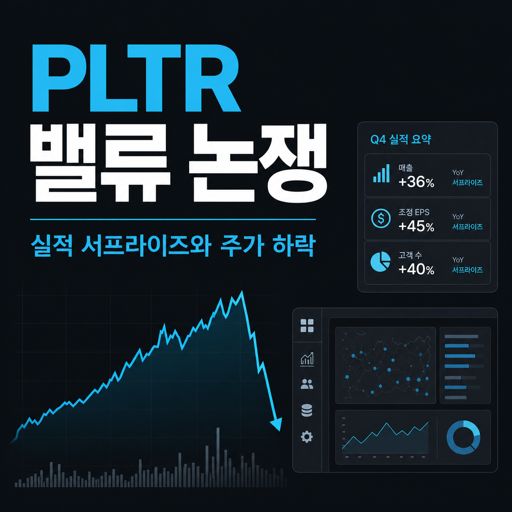
Palantir Technologies (NASDAQ: PLTR) delivered an "earnings surprise" in its Q4 2025 results, exceeding Wall Street expectations. Revenue surged 701 TP3T year-over-year, and earnings per share (EPS) also surpassed the consensus. However, the stock price, which rebounded by over 101 TP3T immediately after the earnings announcement, plunged more than 301 TP3T from its peak in just a few days, leaving investors confused. We will conduct an in-depth analysis of the reasons behind this paradoxical situation where the stock price is falling despite historical earnings.
Understanding the Palantir Business
Palantir is a big data and AI software company founded in 2003 by PayPal co-founder Peter Thiel. Simply put, it acts as a "data brain" that gathers vast amounts of data in one place to find meaningful patterns and insights. It supplies software to government agencies and large corporations, including the U.S. Department of Defense, the Department of Homeland Security, and the IRS. It has three core products. Specialized in the government and defense sectors
Gotham, serving as an enterprise data operating system
Foundry, and the key weapon of the AI era
AIP (AI Platform)In particular, AIP is a platform that enables the immediate application of Large Language Models (LLM) to enterprise operations, and it is becoming the largest engine of Palantir's growth from 2024 onwards. Recently, growth in the U.S. commercial (enterprise) sector has been explosive. The number of commercial clients in the U.S. increased by 491 companies year-over-year to 571, and strategic partnerships with major IT companies such as NVIDIA, Accenture, and Cognizant are also expanding. CEO Alex Karp remarked during the earnings announcement, "This is one of the most iconic results in the company's history.".
Palantir Financial Analysis
📊 Recent 4-Q Sales and Profitability Trends
Palantir's quarterly performance is literally a textbook example of 'accelerated growth.' As shown in the table below, it exhibits a rare pattern of increasing revenue growth every quarter. In particular, the revenue growth rate of 701 TP3T in the fourth quarter of 2025 is the highest since its IPO.
| division |
Q1 2025 |
Q2 2025 |
Q3 2025 |
Q4 2025 |
| take |
$ 884 million (approx. 1.29 trillion won) |
$1.004 billion (approx. 1.46 trillion won) |
$1.181 billion (approx. 1.72 trillion won) |
$ 1.407 billion (approx. 2.05 trillion won) |
| YoY sales growth rate |
+39% |
+52% |
+63% |
+70% |
| Operating Profit (GAAP) |
$ 176 million |
$ 269 million |
$393 million |
$ 575 million |
| Operating Profit Margin (GAAP) |
19.9% |
26.8% |
33.3% |
40.9% |
| net profit |
$ 214 million (approx. 311.8 billion won) |
$ 327 million (approx. 476.3 billion won) |
$ 476 million (approx. 693.5 billion won) |
$ 609 million (approx. 887.3 billion won) |
| Net profit margin |
24.2% |
32.6% |
40.3% |
43.3% |
| Diluted EPS |
$0.08 |
$0.13 |
$0.18 |
$0.24 |
A noteworthy point is the rapid improvement in profitability. The GAAP operating profit margin more than doubled in just four quarters, rising from 19.91 TP3T in Q1 to 40.91 TP3T in Q4. The adjusted operating profit margin reached 571 TP3T in Q4, and the 'Rule of 40' score stood at 1,271 TP3T, marking the highest level in the history of the software industry. The Rule of 40 is a figure calculated by adding revenue growth rate and operating profit margin; a score of 401 TP3T or higher is considered indicative of an excellent SaaS company, and Palantir has exceeded this threshold by more than three times.
📊 Revenue Composition Analysis (As of Q4 2025)
| sector |
Q4 Sales |
YoY growth rate |
specific gravity |
| 🇺🇸 US Commerce |
$ 507 million (approx. 738.7 billion won) |
+137% |
36% |
| 🇺🇸 U.S. government |
$ 570 billion (approx. 830.5 billion KRW) |
+66% |
41% |
| 🌍 Overseas Commerce |
Approximately 1 TP 4 T 165 million |
+8% |
12% |
| 🌍 Foreign governments |
Approximately 1 TP 4 T 165 million |
– |
11% |
| total |
$ 1.407 billion (approx. 2.05 trillion won) |
+70% |
100% |
The U.S. business accounts for 771 TP3T of total revenue, with the U.S. commercial sector showing particularly dominant growth of 1,371 TP3T. As the adoption of AIP gains momentum, large contracts are surging, with 180 deals exceeding $1 million and 61 deals exceeding $10 million concluded in Q4 alone. In contrast, the overseas commercial sector grew by only 81 TP3T, with the expansion of overseas markets being identified as a weakness.
📊 Financial Health Indicators
| characteristic |
black eye |
analysis |
| Cash and short-term investment |
$7.2 billion (approx. 10.5 trillion won) |
ample cash reserves |
| Total debt |
$ 235 million (Lease obligation) |
Practically debt-free management |
| Current ratio |
7.11 times |
Very good (good if more than 2 times) |
| Current ratio |
6.99 times |
Excellent short-term liquidity |
| Debt-to-Equity Ratio (D/E) |
3.06% |
Almost debt-free |
| ROE (Return on Equity) |
25.98% |
Excellent capital efficiency |
| ROA (Return on Assets) |
11.60% |
Good asset management efficiency |
| Gross profit margin |
82.4% |
Top of the software industry |
| 2025 Adjusted Free Cash Flow |
$2.3 billion (approx. 3.35 trillion won) |
Margin 511 TP3T, YoY 821 TP3T growth |
Palantir's financial soundness can be described as impregnable. While it holds 10.5 trillion KRW in cash, it has virtually no financial debt (only lease obligations amount to 235 million KRW). Its current ratio of 7.11 times is sufficient to withstand any short-term crisis. Its gross profit margin of 82.41 is among the highest in the software industry, and the fact that its adjusted free cash flow margin reaches 511.51 demonstrates that its business model generates actual cash, rather than merely increasing revenue. However, Palantir currently does not pay dividends and does not operate a share buyback program.
Palantir Stock Price and Valuation
📈 Stock Price Performance
Palantir's stock price has been undergoing a significant correction after hitting an all-time high of $207.52 (approx. 302,000 KRW) in early November 2025. As of February 11, 2026, the stock price stands at approximately $139.51 (approx. 203,000 KRW), down about 33% from its peak.
| period |
Rate of return |
Compared to the S&P 500 |
| 52-week return |
+21.7% |
Exceeding +6.7%p |
| Decline rate from peak |
-32.8% |
– |
| 50-day moving average |
$172.53 |
-19.1% Lower Chapter |
| 200-day moving average |
$160.34 |
-13.0% Hahoe |
| 52-week low/high |
$66.12 ~ $207.52 |
💰 Valuation Analysis — Key Issues
The hottest debate in Palantir investing is 'valuation.' This is because no matter how good a company is, its investment appeal diminishes if the stock price is too high.
| Valuation Indicators |
Palantir |
Software industry average |
evaluation |
| PER (Price-to-Earnings Ratio, TTM) |
221x |
30~50x |
Extremely overvalued |
| Forward PER |
77x |
25~35x |
Still a high premium |
| PSR (Price-to-Sales Ratio) |
74.3x |
8~15x |
Extremely overvalued |
| PBR (Price-to-Book Ratio) |
45.1x |
5~10x |
Very high |
| EV/EBITDA |
226x |
20~30x |
Extremely overvalued |
| PEG ratio |
3.26 |
1.0~2.0 |
expensive compared to growth |
Palantir's current market capitalization is approximately $332.5 billion (about 484 trillion KRW). A Price-to-Sales Ratio (PSR) of 74 times relative to total 2025 revenue of $4.48 billion implies that years of high growth have already been reflected in the current stock price. In other words, analysts suggest that even assuming Palantir grows by more than 30% annually over the next five years and maintains a net profit margin of 30%, it is difficult to justify the current stock price. This is the core reason why the stock price is falling despite earnings surprises.
Palantir Wall Street Outlook
🏦 Distribution of Analyst Investment Opinions
| Investment opinion |
Current (February) |
1 month ago |
3 months ago |
| 🟢 Strong Buy |
1 |
1 |
1 |
| 🟢 Buy |
11 |
6 |
3 |
| 🟡 Hold |
12 |
16 |
17 |
| 🔴 Sell |
2 |
2 |
2 |
| 🔴 Strong Sell |
1 |
2 |
1 |
A notable change is that buy recommendations have surged from 3 three months ago to 11 currently following the earnings announcement. HSBC upgraded its rating from 'Hold' to 'Buy,' and William Blair also upgraded to 'Outperform.' The consensus target price is $189.92 (approximately 277,000 KRW), representing an upside potential of about 36% from the current share price; however, there is a significant divergence, with the highest target price being Citigroup's $260 (approximately 379,000 KRW) and the lowest being $70 (approximately 102,000 KRW).
🔄 Recent Major Investment Opinion Changes
| date |
securities firm |
Investment opinion |
Target price |
Changes |
| 2/3 |
Citigroup |
Maintain Buy |
$260 ↑ |
$235 → $260 Upward |
| 2/3 |
UBS |
Maintain neutrality |
$180 ↓ |
$205 → $180 Downward |
| 2/3 |
DA Davidson |
Maintain neutrality |
$180 ↓ |
$215 → $180 Downward |
| 1/22 |
Phillip Securities |
New purchase |
$208 |
Coverage Initiation |
| 1/6 |
Truist Securities |
New purchase |
$223 |
Coverage Initiation |
Institutional investors hold 60.81 TP3T, with a total of 3,576 institutions holding shares. Insider (employee) stake is relatively low at 3.61 TP3T, and investor sentiment is being weighed by observed insider selling, such as the recent sale of 20,000 shares by Director Alexander Moore. The short selling ratio is low, at approximately 21 TP3T of total outstanding shares.
Palantir Latest Issues and Stock Price Momentum
🔥 5 Reasons Stock Price Fell Despite Earnings Surprise
1. The Weight of Extreme Valuations: Immediately after the earnings announcement, the stock price rebounded by more than 101 TP3T, but on Wednesday, February 4, just two days later, it plunged 11.61 TP3T in a single day, giving back all of the rebound. Sherwood News reported that “several brokerage firms lowered their target prices based on valuation grounds.” No matter how strong the earnings are, a PSR of 74x and a PER of 221x represent a level where the market demands more than 'perfection,' and even a single factor of uncertainty can trigger a sharp decline.
2. ESG Risks Due to the ICE Controversy: Social controversy surrounding reports that Palantir's AI is being used to process tips by the U.S. Immigration and Customs Enforcement (ICE) has weighed on the stock price. As public opposition to immigration policies intensifies, negative perceptions of Palantir may spread.
3. Re-evaluation of the AI Sector as a Whole: Entering 2026, profit-taking pressure intensified across overvalued AI-related stocks. A "New Year's selling" phenomenon (the opposite of Tax-Loss Selling) emerged as investors sought to realize profits from 2025, and caution regarding the overheating of AI investment weighed down the entire software sector.
4. Overseas business slump: While U.S. sales grew by 931 TP3T, overseas commercial sales growth was only 81 TP3T. CEO Karp explained, “We are holding off on launching new products overseas because domestic demand in the U.S. is too strong,” but the lack of overseas diversification is pointed out as a weakness in terms of long-term growth prospects.
📋 2026 Guidance — The Basis of Confidence
Palantir’s 2026 outlook significantly exceeds market expectations. The 2026 revenue guidance of 7.18 to 7.20 billion (approximately 10.5 trillion KRW) signifies 611 trillion KRW growth year-over-year, surpassing the Wall Street consensus of 6.3 billion KRW by more than 141 trillion KRW. U.S. commercial revenue is forecast to grow by over 1,151 trillion KRW, reaching over 3.14 billion KRW. By projecting adjusted operating profit of 4.13 to 4.14 billion KRW and adjusted free cash flow of 3.93 to 4.13 billion KRW, the company expresses confidence in achieving both high growth and high profitability simultaneously.
🤝 Recent Major Partnerships and Agreements
Palantir recently secured multi-year revenue visibility by signing a major contract worth 100 million TP4T billion with the UK Ministry of Defence. It also announced a strategic alliance with AI chip leader NVIDIA and expanded its partnership with Accenture to deploy AIPs across various industries. Furthermore, it is accelerating AI-based modernization in the healthcare and enterprise operations sectors through collaboration with Cognizant. Daiwa Securities recently upgraded Palantir to 'Buy,' evaluating that the company is "shifting toward larger-scale AI deals.".
Investment Strategy and Risk Factors
✅ Investment Appeal
- The biggest beneficiary of the AI era: As the adoption of AI accelerates in both government and businesses, Palantir's AIP possesses unrivaled competitiveness.
- Accelerated Growth Trajectory: A rare pattern of increasing sales growth every quarter (39% → 52% → 63% → 70%)
- Ironclad Finance: Cash 1 TP 4 T 7.2 billion, Debt-free management, Free cash flow margin 511 TP 3 T
- High entry barriers: 20 years of accumulated know-how in government and defense data analysis and security certification
- Aggressive Guidance: The 2026 growth forecast of 61% expresses management's strong confidence.
⚠️ Key Risk Factors
- Extreme Valuation: A P/E of 221 and a P/S of 74 are expensive by any standard, and a sharp decline is possible even with a slight shortfall from expectations.
- Overseas growth sluggish: The overseas commercial sales growth rate of 8% is a weakness in the long-term growth story.
- Insider Selling: Continuous stock selling by management and directors is a negative signal.
- High volatility: With a beta of 1.69, volatility is approximately 701 TP3T higher than the market average.
- Stock-Based Compensation (SBC) Dilution: Continued increase in the number of shares due to large-scale stock option exercises
💡 Strategies by Investor Type
🔵 Conservative Investor: Entering the market at the current valuation is burdensome. It is safer to start staggered buying at the $100–110 level (approximately 146–160,000 KRW), where the P/E ratio drops below 100. Limit your portfolio weight to within 3–5%.
🟡 Neutral Investor: The current stock price level ($139) represents a correction of 33% from the peak, but the absolute valuation remains high. Consider entering the market in the $120–$140 range using a split buying strategy, but it is strongly recommended not to exceed 5–8% of your total investment.
🔴 Active Investor: If you are confident in the long-term benefits of the AI revolution, the current correction could be a buying opportunity. However, due to the significant downside risk, be sure to set a stop-loss line ($100 or a break below the 200-day moving average) and manage your portfolio so that it does not exceed 10%.
Conclusion: When Will the Discrepancy Between Earnings and Stock Prices Narrow?
Palantir is undoubtedly one of the most powerful platform companies in the AI era. Its revenue growth rate of 701 TP3T, operating profit margin of 411 TP3T, and free cash flow margin of 511 TP3T are figures rarely seen in the software industry. However, in the stock market, a "good company" and a "good investment" are not always the same. It is a reasonable market judgment that Palantir's current stock price already reflects high growth for the next five years or more. This is why the paradox of a declining stock price occurs despite historical performance. What matters to investors is not the quality of Palantir's business, but the valuation question of "is it worth buying at this price?" In the short term, volatility in the AI sector and valuation pressures may suppress the stock price. However, if AI adoption accelerates in the mid-to-long term and Palantir's earnings meet aggressive guidance, a "growth-driven valuation normalization" could occur over time, where earnings catch up with the valuation. For now, it is a wise choice to approach this with patience and a split buying strategy.
⚠️ Investment Precautions: This article is written for informational purposes only and does not constitute a recommendation to buy or sell any specific stock. All investment decisions must be made at the investor's own discretion and responsibility. The exchange rate applied is 1 USD = approximately 1,457 KRW as of February 11, 2026.
※ This analysis utilized AI tools during the writing process, and the final content has been verified by the author. It is for informational purposes only, and investment decisions and responsibilities lie solely with the investor.