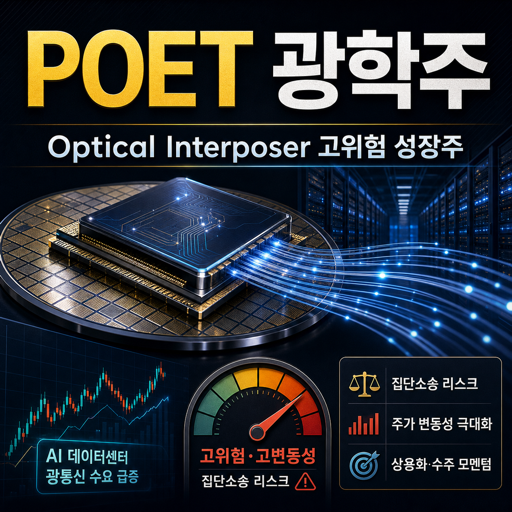
POET Technologies (POET) is a Toronto-based opto-semiconductor development company aiming to integrate electronic and optical components onto a single chip using an 'Optical Interposer' platform. Although the stock surged approximately 1,941 TP3T over the past year driven by the theme of AI data center optical transceivers, it is currently experiencing extreme volatility as the average analyst target price falls below the current price and risks associated with securities class action lawsuits have come to the forefront.
Base Exchange Rate: 1 USD = 1,508 KRW (As of 2026-06-01) · Analysis Date: 2026-06-01 · Current Price: $12.29 (Approx. 18,533 KRW)
index
- Key Summary of POET Stock Price Outlook
- What kind of company is POET?
- Key terms to know before Poet analysis
- Poet Recent Q4 Earnings Analysis
- Poet fair stock price analysis
- Poet vs. Competitor Comparison
- Poet Growth Outlook and Key Drivers
- Poet 12-Month Target Price Scenario
- Poet's Recent Major Issues
- Key Risks in Poet Investment
- Poet Investment Opinion Conclusion
- 5 Frequently Asked Questions about Poet
Key Summary of POET Stock Price Outlook
Poet Technologies' 12-month baseline target price is $9.50 (approx. 14,326 won).
The investment recommendation is Sell (Underweight).
The key reason is that the average analyst target price of 1 TP 4 T 8.20 (approximately 12,366 won) is significantly below the current price, compounded by class action lawsuit risks.
- Although there is commercialization momentum such as Lumilens supply contracts, TTM revenue is only about 1.07M, which is insufficient to justify a market capitalization of about 3.1985 trillion won.
- With cash holdings of approximately 472.6 billion won, short-term liquidity is sound, but there is a possibility of further dilution due to an annual net loss of approximately 94.9 billion won.
- With a 52-week range of 3.87 (approx. 5,836 won) to 20.81 (approx. 31,381 won) and a short selling ratio of approximately 9.61 TP3T, speculative volatility is very high.
What kind of company is POET?
Poet Technologies is an opto-semiconductor company headquartered in Toronto, Canada (80 full-time employees). Its predecessor was Opel Technologies, and it changed its name to its current name in 2013.
The core asset is the 'POET Optical Interposer,' a platform that integrates electronic and optical devices onto a single chip using a wafer-level semiconductor process. It supplies optical integrated circuits (PICs), optical engines, optical transceiver modules, and light source products.
The business model consists of the supply of optical engines and modules, and revenue from NRE (Non-Repetitive Engineering). Key demand sources include AI data centers, light sources, telecommunications (5G and PON), and sensing (LiDAR and OCT) markets.
The competitive landscape is the optical integration and optical engine market, where it competes with silicon photonics-based companies and mass-producers of optical components. Purely listed competitors with direct comparison are rare, and it shares themes with AI optical communication component stocks.
Key terms to know before Poet analysis
- Optical Interposer: Poet’s core platform that integrates electronic and optical components onto a single chip. The company claims that its strength lies in reducing packaging costs and size.
- PIC (Photonic Integrated Circuit): Optical Integrated Circuit. A component that integrates various optical functions into a single chip, serving as the core of an optical transceiver.
- NRE (Non-Recurring Engineering): Non-recurring engineering revenue. As compensation for customized development, it is a one-time transaction unlike mass production revenue. A significant portion of Poet's revenue comes from this.
- Optical Engine: A component with modularized optical transmission and reception functions. Used for high-speed connections in AI data centers.
- PFIC (Passive Foreign Investment Company): Passive foreign investment company. This results in tax disadvantages for U.S. shareholders and is one of the issues in the Poet class action lawsuit.
Poet Recent Q4 Earnings Analysis
Poet is a company in the development and early commercialization stages, with quarterly revenue remaining at the level of several hundred thousand dollars. While revenue is on an upward trend, its absolute scale is insignificant.
| branch | Sales (USD) | Net Profit/Loss (USD) | EPS |
|---|---|---|---|
| Q2 2025 | $268,469 | -$17.26M | -$0.21 |
| Q3 2025 | $298,434 | -$9.37M | -$0.10 |
| Q4 2025 | $341,202 | -$42.67M | n/a |
| Q1 2026 | $503,389 | -$12.34M | -$0.08 |
In the recently announced earnings (Q1 2026, May 14), NRE and product sales were Form 6-K filed with the SEC The standard was $503,389, a significant increase compared to $166,760 in the same period of the previous year.
However, the net loss continued at -$12.34M (approximately -18.6 billion KRW). EPS is -$0.08.
Financial soundness is sound. With cash of approximately 1 TP4T313.4M (approximately 472.6 billion KRW) and total liabilities of 1 TP4T7.07M, it is virtually debt-free, and the current ratio is 2.19.
However, cash depletion continues with a TTM net loss of approximately -$62.96M (approx. -94.9 billion KRW) and an operating cash flow of -$31.1M. Compared to a market capitalization of approximately $2.121B (approx. 3.1985 trillion KRW), TTM revenue is only approximately $1.07M, resulting in a P/S ratio of approximately 1,973 times, rendering traditional valuation metrics meaningless.
Poet fair stock price analysis
Since both revenue and operating cash flow are negative, the cash flow-based DCF cannot yield a meaningful fair value. Therefore, this analysis combines a scenario-based option valuation approach weighted by the probability of commercialization success with analyst consensus.
| DCF assumption items | Usage value | reason |
|---|---|---|
| Discount rate (WACC) | 13% | High risk and high volatility in the development stage |
| End-of-life value growth rate (g) | 3.0% | Long-term GDP + Inflation |
| forecast period | 10 years | Prolonged visibility of commercialization |
| Base FCF | Negative (TTM) | Continued depletion of cash |
| Bull FCF | Switch to +$40M after 5 years | Lumilens · Mass production of optical engines |
| Bear FCF | Continuous -$50M | Commercialization Delay, Lawsuit, Dilution |
The fair value is not a single value but is presented as a broad range of 5.50 (approx. 8,294 KRW) to 16.00 (approx. 24,128 KRW), depending on the success of commercialization. The average target price of two analysts is 8.20 (approx. 12,366 KRW), which is significantly lower than the current price.
The current price of $12.29 (approx. 18,533 KRW) reflects the expected value of optical interposers by approximately $10, even excluding cash holdings (approx. $2.37 per share); however, considering that commercial sales have not yet been verified, we assess this as overvalued. Mass production revenue will be generated. Lumentum (LITE), a leading stock in mass production of AI optical communicationCompared to that, the gap in sales visibility is distinct.
Poet vs. Competitor Comparison
| item | POET | Lightwave Logic | Lumentum | Corning |
|---|---|---|---|---|
| Market capitalization | Approx. $2.12B | Approx. $1.67B | Approx. $7B | Approx. $40B+ |
| TTM Sales | Approx. $1.07M | Approximately $0.24M | Approx. $1,500M | Approximately $14,000M |
| Operating profit margin | negative | negative | single digit | Approx. 19% |
| Forward P/E | n/a | n/a | About 20 times the normal range | About 60 times the normal range |
| Differentiating factors | Optical interposer integration | EO Polymer IP | Mass production of optical components | Fiber optic integration |
While Poet leads Lightwave Logic in revenue volume and NRE traction, it lags significantly behind mass-production companies like Lumentum and Corning in terms of revenue, margins, and scale. Its only advantage is the potential of its optical interposer integration technology, which remains an unproven option until commercial mass production. A strong player in optical fiber vertical integration. Corning (GLW), a beneficiary of AI data center fiber opticsThere is a significant difference in business maturity between the departments.
Poet Growth Outlook and Key Drivers
Past revenue growth is difficult to interpret due to its small absolute scale, and the analyst consensus (average 1TP/4T/8.20) suggests a decline relative to the current price, while industry growth (AI optical transceivers) is strong. In other words, the key is how much of this industry growth Poet captures in actual revenue.
Growth drivers include the Lumilens supply contract, entry into mass production of optical engines, and plans to expand wafer manufacturing capacity tenfold by 2027. While the increase in quarterly revenue to $503K is positive, it remains insignificant.
Full-scale growth depends on whether sales from the mass production of optical engines and optical interposers become visible. Targeting AI data centers with short-distance connection chips. CRDO, a beneficiary of AI data center connectivityIt is important whether earnings momentum is confirmed by numbers, as in this case.
Poet 12-Month Target Price Scenario
The scenario weights are set at base 401 TP3T / bullish 251 TP3T / bearish 351 TP3T, giving more weight to the bearish trend, reflecting that analyst consensus is significantly below the current price and downside risks such as class action lawsuits and short selling reports have accumulated.
- Base (Base, 40%): $9.50 (approx. 14,326 KRW). Commercialization progress continues, but revenue conversion is delayed, and valuation is being adjusted toward the consensus.
- Bull (25%): $16.00 (approx. 24,128 KRW). Mass production of Lumilens and optical engines begins in earnest; benefits for AI optical communication re-evaluated.
- Bear (Bear, 35%): $5.50 (approx. 8,294 KRW). Negative factors from class action lawsuits, customer attrition, dilution from paid-in capital increase, and resolution of theme overheating.
The weighted expected return is (9.50×0.40 + 16.00×0.25 + 5.50×0.35 − 12.29) / 12.29 ≈ -20.91 TP3T. The expected return is clearly negative, and the risk-adjusted attractiveness is low.
Poet's Recent Major Issues
- 2026 Q1 Earnings (5/14): NRE/Product Revenue $503K (increase from $167K last year), Net Loss -$12.34M.
- Stock price volatility: After a surge of approximately +651 TP3T over 1 month and +1,211 TP3T over 3 months, there has been a recent short-term sharp decline (repeating weekly levels around -71 TP3T).
- Class Action: Multiple securities class action lawsuits filed regarding PFIC tax status, confidentiality violations, and customer order cancellations. Wolfpack Research short-selling reports exist.
- Expansion Plan: Announcement of a tenfold expansion of wafer manufacturing capacity by 2027.
Key Risks in Poet Investment
- Legal and litigation risks → Class action lawsuits and PFIC tax issues damage reputation and finance → Monitoring: Lawsuit progress, settlement size, and customer churn.
- Failure to commercialize and convert to revenue → Stock price plummets due to the expiration of optical interposer option value → Monitoring: Quarterly mass production sales · Lumilens contract fulfillment rate.
- Valuation and Volatility → Market cap of 3.1985 trillion KRW relative to revenue, P/S of approximately 1,973x; sharp decline if theme weakens → Monitoring: Trading volume and short selling ratio (approx. 9.61 TP 3 T).
- dilution of funds → Dilution of per-share value upon paid-in capital increase due to annual loss of approximately 94.9 billion KRW → Monitoring: Trends in cash balance and number of issued shares.
Risk mitigation factors include cash of approximately 472.6 billion won and virtually no debt, which increases the likelihood of short-term survival, and verifiable progress indicators such as increased NRE sales.
Poet Investment Opinion Conclusion
The investment rating is Sell (Underweight), and the confidence level is Medium. The time horizon is 12 months, and new entry is not recommended until the analyst consensus is significantly below the current price and the uncertainty regarding class action lawsuits is resolved.
Existing holders should consider reducing their exposure to manage volatility. It is unsuitable for fundamental investors, and should be approached only by investors betting on option-like performance, with a mindset of minimal capital and high risk. As a high-risk stock in the same theme High-risk AI optical communication stock AAOIVolatility management is essential along with this.
5 Frequently Asked Questions about Poet
Q1. What is POET's 12-month target price?
The base scenario is $9.50 (approx. 14,326 KRW), bullish $16.00 (approx. 24,128 KRW), and bearish $5.50 (approx. 8,294 KRW). The weighted expected return is approximately -20.9%, and the investment opinion is Sell (Underweight).
Q2. Why is Poet classified as a beneficiary of AI optical communication?
This is because optical interposers can integrate electronic and optical components onto a single chip, enabling their application in optical transceivers and optical engines for AI data centers. The supply contract with Lumilens and plans to expand wafer manufacturing capacity tenfold are raising expectations for commercialization.
Q3. Is Poet's current stock price overvalued or undervalued?
It is overvalued. While TTM revenue is only about 1.07M, the market capitalization is approximately 3.1985 trillion KRW, resulting in a P/S ratio of about 1,973. The average analyst target price of 8.20M is also below the current price.
Q4. Which is more attractive to invest in, Poet or Lightwave?
Although both are in the deficit development phase, Poet has the lead in revenue traction due to NRE sales and entry into mass production of optical engines. On the other hand, Lightwave operates on a materials IP licensing model. While Poet has the advantage in revenue visibility, it faces the additional risk of class action lawsuits.
Q5. What is the biggest risk when investing in Poet?
The issues include securities class action lawsuits and failures in commercialization and revenue conversion. Lawsuits regarding PFIC tax status and customer attrition are ongoing, and there is also a risk of dilution from the paid-in capital increase due to an annual loss of approximately 94.9 billion won. The progress of the lawsuits and mass production sales must be monitored as key indicators.
Sources
- POET Technologies Q1 2026 Form 6-K (SEC EDGAR)
- POET Technologies Q1 2026 Results
- POET Technologies Lawsuits and Valuation Risk
This content is for informational purposes only and does not constitute an investment solicitation. Investment decisions and responsibilities rest solely with the investor.
※ This article was written based on publicly available data with the assistance of AI research tools, and the content was reviewed by the author prior to publication. It is for informational purposes only and does not constitute an investment recommendation.