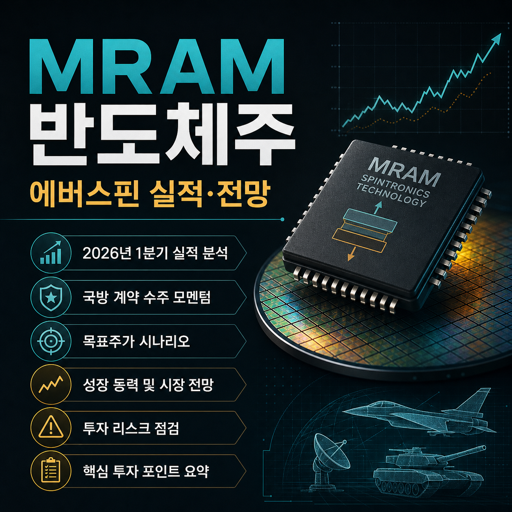
Everspin Technologies (MRAM) is a U.S. semiconductor-related stock that mass-produces non-volatile memory MRAM. Since the beginning of 2026, its stock price has surged approximately 4,571 TP3T in one year, driven by defense contracts and improved earnings. Based on a 12-month baseline target price of 1 TP4T25 and a sell rating, the stock has entered a high-volatility zone.
Analysis Date: 2026-05-29 · Applied Exchange Rate: 1 USD = 1,500 KRW · Current Price $31.26 (approx. 46,890 KRW)
index
- Key Summary of Everspin MRAM Stock Price Outlook
- What kind of company is Everspin (MRAM)?
- Key Terms You Need to Know Before Analyzing Everspin
- Analysis of Everspin's Recent Q4 Earnings
- Everspin Fair Stock Price Analysis (DCF/Multiple)
- Everspin vs. Competitor Comparison
- Everspin Growth Outlook and Key Drivers
- Everspin 12-Month Target Price Scenario
- Everspin's Recent Major Issues
- Key Risks When Investing in Everspin
- Everspin Investment Opinion Conclusion
- 5 Frequently Asked Questions about Everspin
Key Summary of Everspin MRAM Stock Price Outlook
The 12-month baseline target price for Everspin (MRAM) is $25 (approximately 37,500 won).
The investment recommendation is Sell.
The key reason is that valuation pressure has accumulated as the stock price has significantly outpaced fundamentals due to a surge of approximately 4,571 TP3T over the past year.
Everspin is virtually the only pure mass-production company of MRAM, a non-volatile memory for industrial, automotive, aerospace, and defense applications. Revenue in the first quarter of 2026 increased by 141% year-on-year, and investor sentiment improved rapidly as the company secured a contract worth 140 million (approximately 60 billion KRW) with the U.S. defense supply chain.
However, the current price of $31.26 (approx. 46,890 won) exceeds the average target price of $18 (approx. 27,000 won) from only two analysts by about 74%. Multiples of approximately 12.9 times the price-to-sales ratio (P/S) and approximately 67 times the forward P/E ratio are difficult to justify for a company growing by 14% annually.
- Investment Point 1: MRAM Mass Production Entry Barriers and Long-term Demand in Defense and Industrial Sectors
- Investment Point 2: $40M Defense Contract and 10-Year U.S. Domestic Production Agreement with Microchip
- Investment Point 3: Near-debt-free financial structure and early phase of turnaround to profitability
What kind of company is Everspin (MRAM)?
Everspin Technologies is a semiconductor memory company founded in 2008 and headquartered in Chandler, Arizona, USA.
The core products are toggle MRAM, STT-MRAM, and TMR magnetic sensors. It supplies memory and foundry services to the industrial, medical, automotive, aerospace, and data center markets.
Sales of MRAM products account for the majority of revenue, with licensing and royalty revenue contributing a portion. The business model combines the sale of proprietary products with MTJ-based foundry services.
In the competitive landscape, Everspin is virtually unrivaled as an independent MRAM mass producer and indirectly competes with major memory companies such as Micron and Samsung Electronics in the broader non-volatile memory market. With approximately 85 employees, it is classified as a small-cap stock.
Key Terms You Need to Know Before Analyzing Everspin
- MRAM (Magnetoresistive RAM)
- Non-volatile memory utilizing magnetoresistance. It retains data even when the power is off and has a long write life, making it suitable for industrial and defense applications. It is Everspin's core product line.
- Toggle MRAM
- Everspin's first-generation MRAM technology. Due to its high durability and reliability, it is used in high-reliability applications such as defense and aerospace. It is the technology covered by the $40M defense contract.
- STT-MRAM (Spin-Transfer Torque MRAM)
- High-density MRAM using the spin transfer torque method. It is considered a next-generation growth engine as it enables high capacity with smaller cell sizes.
- TMR sensor (Tunnel Magnetoresistance)
- A magnetic sensor utilizing the tunnel magnetoresistance effect. It serves as a key pillar for revenue diversification beyond memory.
Analysis of Everspin's Recent Q4 Earnings
TTM revenue for the past four quarters (Q2 2025 to Q1 2026) is approximately $56.9M (approximately 85.4 billion KRW). Quarterly revenue showed a gradual upward trend from $13.2M to $14.9M.
| branch | Sales (USD M) | Sales (won) | GAAP Net Income (USD M) | GAAP EPS |
|---|---|---|---|---|
| Q2 2025 | $13.2M | Approximately 19.8 billion won | -$0.67M | -$0.03 |
| Q3 2025 | $14.1M | Approximately 21.2 billion won | +$0.05M | $0.00 |
| Q4 2025 | $14.8M | Approximately 22.2 billion won | +$1.20M | +$0.05 |
| Q1 2026 | $14.9M | Approximately 22.4 billion won | -$0.30M | -$0.01 |
Quarterly earnings on a GAAP basis hover near the break-even point, fluctuating between a surplus and a deficit. Since TTM net income is virtually close to zero, the trailing PER is meaningless.
Profitability is on an improving trend. The GAAP gross profit margin rose to 52.71 TP3T in the first quarter of 2026, up from 51.41 TP3T in the same period of the previous year, with improved capacity utilization being the main factor.
Financial soundness is sound. As of the end of the first quarter of 2026, cash stands at approximately 1 TP4T40.5M (approximately 60.8 billion KRW) and total liabilities at approximately 1 TP4T3.0M (approximately 4.5 billion KRW), making it virtually debt-free. With a current ratio of 5.8 times and a quick ratio of 4.6 times, there are no issues with short-term liquidity.
However, free cash flow is highly volatile. In the first quarter of 2026, FCF recorded approximately -$4.3M (approximately -6.5 billion KRW) due to increased capital expenditure. Investment in expanding production capacity in the U.S. is putting pressure on short-term cash flow.
The most recently announced Q1 2026 results met the upper end of the guidance. With revenue of 14.9M (approx. 22.4 billion KRW) and non-GAAP EPS of 0.11, the company achieved the upper end of the guidance range of 14M to 15M. MRAM product revenue surged by 281M year-over-year to 14.1M (approx. 21.2 billion KRW), while license and royalty revenue decreased to 0.8M from 2.1M in the previous year. Detailed figures are Q1 2026 Earnings Call Full TextYou can check it at.
The Q2 guidance projected revenue of $15.5M–$16.5M (approx. 23.3 billion KRW–approx. 24.8 billion KRW) and non-GAAP EPS of $0.00–$0.03. While revenue growth continues, profits remain at the break-even level.
Everspin Fair Stock Price Analysis (DCF/Multiple)
Current valuations are excessive relative to fundamentals. The price-to-sales ratio (P/S) is approximately 12.9 times, the price-to-book ratio (P/B) is approximately 10.4 times (Net Asset Value per Share: $2.999, approximately 4,499 KRW), and the forward P/E ratio is approximately 67 times. This is a burdensome level for a company growing at an annual rate of 14%.
The assumptions used to calculate the fair value of the DCF are as follows.
| DCF assumption items | Usage value | reason |
|---|---|---|
| Discount rate (WACC) | 12% | Beta 1.76, reflecting the cost of capital for small-cap stocks |
| End-of-life value growth rate (g) | 3.0% | Long-term GDP + Inflation |
| forecast period | 5 years | Product Cycle Visibility |
| Base FCF | Approximately $5M | Normalization TTM FCF Estimation |
| Bull FCF assumption | Base × 1.4 | Defense and STT Sales Accelerate |
| Bear FCF assumption | Base × 0.7 | Continued capital investment and slowing demand |
The formula applied was Fair Value = Σ[FCFₜ/(1+WACC)ᵗ] + terminal value/(1+WACC)ᴺ, terminal value = FCF_N×(1+g)/(WACC−g).
Based on this assumption, the DCF fair value per share is in the range of approximately $14 to $20 (approximately 21,000 KRW to 30,000 KRW). This aligns with the average target price of two analysts, $18 (approximately 27,000 KRW), and the model fair value, $18. The current price, $31.26, significantly exceeds this range.
The burden is also confirmed in historical and peer comparisons. The extreme volatility ranging from the 52-week low of $5.5 (approx. 8,250 won) to the high of $51.5 (approx. 77,250 won) suggests that momentum and thematic supply and demand, rather than fundamentals, drove the stock price. The valuation is assessed as overvalued.
Everspin vs. Competitor Comparison
| item | Everspin (MRAM) | Micron (MU) | SanDisk (SNDK) | Samsung Electronics |
|---|---|---|---|---|
| Market capitalization | Approx. $733M | formation | medium to large | Super-sized |
| TTM Sales (USD M) | Approximately 57M | very large | 큼 | very large |
| TTM Sales Growth Rate (YoY) | Approx. 14% | height | recovery phase | middle |
| Operating Margin(TTM) | Approx. -21 TP3 T (break-even) | black checkers | black checkers | black checkers |
| Forward P/E | About 67 times | lowness | lowness | lowness |
| Key differentiators | No. 1 in independent MRAM mass production | HBM and DRAM scale | NAND flash | Comprehensive Memory |
Everspin holds an advantage in the entry barriers of the niche MRAM market and reliability for defense and industrial applications. On the other hand, it is at a disadvantage compared to large memory companies in terms of sales volume, profitability, and valuation attractiveness.
Micron, which possesses HBM, benefits more directly from the AI memory cycle. Related analysis is Analysis of HBM Benefits for Micron (MU), the Leading AI Memory Stockand NAND flash recovery stocks SanDisk (SNDK) Memory Semiconductor Stock Fair Value ForecastIt is good to refer to this together.
Everspin Growth Outlook and Key Drivers
Growth rate estimates were calculated by weighting past performance, consensus, and industry growth rates. Reflecting a past 3-5 year revenue CAGR of approximately 81 TP3T (weighted 0.4), an analyst consensus of approximately 121 TP3T (weighted 0.4), and an MRAM industry growth rate of approximately 151 TP3T (weighted 0.2), the weighted expected growth rate is approximately 111 TP3T.
There are three key growth drivers. First, the $40M defense contract and entry into the U.S. defense supply chain. Second, supply stability and capacity expansion through a 10-year U.S. domestic production agreement with Microchip. Third, demand for high-reliability non-volatile memory in edge AI, wearables, and automobiles.
The structural growth of the semiconductor design ecosystem is also an indirect favorable factor. The low-power semiconductor design trend is Growth Analysis of ARM Holdings, a Powerhouse in AI Semiconductor DesignIt is covered in more depth in...
However, the small absolute sales volume and the high quarterly volatility due to single contracts and single customers are factors that lower the quality of growth.
Everspin 12-Month Target Price Scenario
The base scenario target price is $25 (approximately 37,500 won). While revenue growth continues, the overheated multiple is gradually normalizing, reflecting a slight decline from the current price.
The target price for the bullish scenario is $42 (approximately 63,000 won). This assumes that defense revenue is recognized quickly and new STT-MRAM orders accelerate.
The target price for the bearish scenario is $15 (approximately 22,500 won). This applies when momentum cools and the stock price reverts to the DCF/analyst fair value (around $18).
The scenario probabilities were allocated as follows: base 451 TP3T, bullish 201 TP3T, and bearish 351 TP3T. Given the significant valuation burden resulting from a surge of approximately 4,571 TP3T over the past year, while the pace of fundamental improvement is gradual, it was determined that it is reasonable to assign heavier weight to downside risk than upside risk. Furthermore, volatility in both directions is high due to low free float and a short selling ratio reaching approximately 121 TP3T of outstanding shares.
The weighted expected price is approximately $24.9 (approximately 37,350 won), and compared to the current price of $31.26, the expected return is approximately -20%. Since the expected return is negative, the investment opinion is Sell.
Everspin's Recent Major Issues
The biggest issue over the past three months has been defense contracts. Everspin has signed a subcontract worth $40M (approximately 60 billion KRW) over two years and six months to provide toggle MRAM process and engineering for a customer based in the U.S. defense industry. The details of the contract are as follows. Reports regarding defense contractsIt is confirmed in.
On April 8, 2026, a 10-year strategic manufacturing agreement was announced with Microchip Technology to expand domestic production capacity for MRAM and TMR sensors. This is positive for supply stability and defense supply chain qualification.
On the other hand, some market experts expressed caution regarding the short-term surge. The original text of the quarterly report is Performance data filed with the SECYou can verify this directly. Future catalysts are the timing of defense revenue recognition, new STT-MRAM orders, and whether quarterly profitability is established.
Key Risks When Investing in Everspin
Risk 1 — Valuation Retracement. The current price exceeds the analyst fair value by 741 TP3T → If momentum cools, a sharp drop to around 1 TP4T18 is possible → Indicators to monitor: P/S multiple, daily average trading volume, breakout below the 50-day moving average.
Risk 2 — Revenue Concentration and Small-Cap Volatility. Due to small absolute revenue, a single contract delay shakes quarterly earnings → Stock price shock amplified in the event of guidance misses → Monitoring indicators: Quarterly guidance achievement rate, license revenue trends.
Risk 3 — Unstable Profitability. GAAP earnings fluctuate between profit and loss quarterly → Financial pressure if FCF deficits persist due to expanded capital investment → Monitoring indicators: GAAP operating profit margin, quarterly FCF, cash balance.
Risk 4 — Short Selling and Supply & Demand Volatility. Short selling is high at approximately 121 TP3 T of outstanding shares → Increased volatility in both directions of short squeezes and sharp declines → Monitoring indicators: Short selling balance, borrowing ratio. Volatility in defense and thematic stocks is Case Study of ONDS, an AI Defense StockIt shows a pattern similar to .
Mitigation factors include a near-debt-free financial structure and cash of approximately 1 TP4T40.5M (about 60.8 billion KRW) supporting short-term viability.
Everspin Investment Opinion Conclusion
The investment recommendation is Sell, and the confidence level is Medium. The company's technological moat and defense and industrial demand are attractive, but the current stock price has excessively reflected these factors.
The investment timeframe is 12 months, and an expected return of approximately -201 TP3T corresponds to a selling zone. New entries are not recommended, and existing holders should consider reducing their holdings. However, this analysis is for informational purposes only and does not constitute an investment recommendation.
5 Frequently Asked Questions about Everspin
Q1. What is the 12-month target price for Everspin (MRAM)?
Based on the base scenario, the level is $25 (approx. 37,500 won), suggesting a bullish range of $42 (approx. 63,000 won) and a bearish range of $15 (approx. 22,500 won). The weighted expected return is approximately -20%, which is a sell zone.
Q2. Why is Everspin classified as a beneficiary of the U.S. semiconductor and defense industries?
This is because TOGGLE MRAM was adopted by the U.S. defense supply chain, securing a $40M (approximately 60 billion KRW) contract and signing a 10-year domestic production agreement with Microchip. MRAM is a high-reliability non-volatile memory suitable for defense and aerospace applications.
Q3. Is Everspin's current stock price overvalued or undervalued?
It is overvalued. The P/S is approximately 12.9x and the forward PER is approximately 67x, with a DCF fair value of $14 to $20 (approx. 21,000 won to 30,000 won). The current price of $31.26 (approx. 46,890 won) significantly exceeds this range.
Q4. Which is more attractive to invest in, Everspin or Micron?
Micron holds the advantage in terms of sales volume, profitability, and valuation attractiveness. Micron also benefits significantly from the High-Blockchain Memory (HBM) cycle. While Everspin's strength lies in its niche MRAM market with high entry barriers, its current stock price is burdensome.
Q5. What is the biggest risk when investing in Everspin?
The valuation retracement is the most significant. As the current price exceeds fair value by 741 TP3T, there is a risk of a sharp decline if momentum cools. Small-cap volatility due to revenue concentration and a short selling ratio of approximately 121 TP3T are also key risks.
Sources
- Everspin Q1 2026 8-K Earnings Data (SEC EDGAR)
- Everspin Q1 2026 Earnings Call Transcript (Motley Fool)
- Everspin $40M Defense Contract (Investing.com)
※ This article was written based on publicly available data with the assistance of AI research tools, and the content was reviewed by the author prior to publication. It is for informational purposes only and does not constitute an investment recommendation.