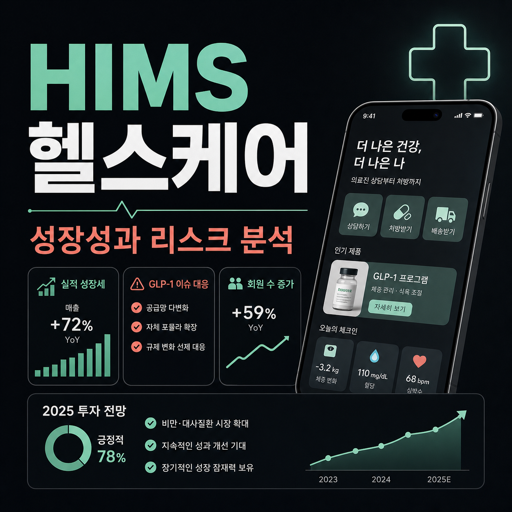
We have conducted a complete analysis of the 2025 investment outlook for HIMS stock. Check the financial performance, response to GLP-1 issues, target price, and risks of HIMS, the leading telehealth stock, all in one go.
HIMS (Hims & Hers Health, Inc.) is currently one of the most 주목받는 growth stocks in the U.S. telehealth market. Leading digital healthcare innovation, the company is continuing its rapid growth through a Direct-to-Consumer (D2C) model that provides personalized medical services directly to consumers.
As of 2025, while the stock price is exhibiting significant volatility, it is still considered an attractive investment opportunity from a long-term perspective, driven by the structural growth of the telehealth market. In particular, investors are focusing on how the company will overcome challenges such as recent FDA regulatory issues and changes in the GLP-1 market.
Understanding What HIMS Does and Business Models
HIMS is an innovative telehealth platform that uses digital technology to overcome the limitations of the traditional medical system. Patients can consult with medical professionals via smartphone apps or websites and conveniently receive personalized treatment and prescription medication at home. This is an effective solution to address issues such as accessibility, high costs, and long waiting times in the existing medical system.
The company's core strength lies in its subscription-based business model. Customers pay a monthly subscription fee to receive ongoing care across various areas, including sexual health, skincare, hair care, weight management, and mental health. This model offers the advantage of increasing revenue predictability and maximizing customer lifetime value.
As of 2025, HIMS has approximately 1.8 million subscribers, and over 901% of total revenue consists of repeat purchases. This is an indicator of high customer satisfaction and excellent service quality. In particular, the company's growth is accelerating as GLP-1 class weight loss drug services and male testosterone treatment services have recently emerged as major growth drivers.
A Journey of Explosive Growth and Profitability Improvement
Looking at HIMS's financial performance, it truly exemplifies explosive growth. Revenue increased from $527 million in 2022 to $872 million in 2023, and then surged again to $1.48 billion in 2024. With a target of reaching $2.3–2.4 billion in 2025, the company is maintaining an average annual growth rate of over $601.
Even more impressive is the improvement in profitability. The company, which had recorded deficits until 2023, finally succeeded in turning a profit in 2024, and the net profit margin improved to 8.51 TP3T. This signifies that the fundamental competitiveness of the business model has been proven, rather than merely an expansion of scale. The gross profit margin also remains at a high level of over 761 TP3T, demonstrating that it is an excellent business model equipped with both scalability and profitability.
A closer look at quarterly performance reveals an even more interesting pattern. While the company recorded an all-time high quarterly revenue of $586 million in the first quarter of 2025, it fell to $545 million in the second quarter, a decrease of 71 TP3T. Although this appears to be due to temporary seasonal factors, the company still recorded a strong growth rate of 72.51 TP3T year-over-year, confirming that its fundamental growth momentum remains intact.
Financial soundness and cash generation ability
HIMS's financial health is very sound. The company holds approximately $300 million in cash, and with debt amounting to only $11.34 million—mostly consisting of lease obligations—it is effectively operating on a debt-free basis. With a current ratio of 4.98 and a quick ratio of 4.23, short-term liquidity is also at a very safe level.
Of particular note is its cash generation capability. In 2024, it recorded $251 million in operating cash flow and $198 million in free cash flow, demonstrating a healthy cash generation structure. This implies that the company possesses the self-sufficiency to sustain growth without relying on external financing.
Based on this abundant cash, the company is pursuing an active shareholder return policy. In 2024 alone, it conducted a share buyback worth $83.04 million, suggesting that management believes the current stock price is undervalued. At the same time, it is not neglecting to secure future growth engines by investing $78.82 million in R&D.
The Two Sides of Stock Performance and Volatility
The most significant characteristic of HIMS stock is its extremely high volatility. It showed a price fluctuation range of a staggering 3,541 TP3T, ranging from a 52-week low of $16.05 to a high of $72.98. This is confirmed by a beta coefficient of 2.14, which exhibits the typical characteristics of a high-volatility growth stock that moves more than twice the market average.
This volatility is starkly evident when examining the stock price trends in 2025. After forming a low point in the $29-$37 range in late March, the stock price surged 251 TP3T to $35 following the earnings announcement on April 29, and then skyrocketed 1,201 TP3T to $67 in mid-May, setting a new yearly high. However, as FDA issues emerged on June 23, the stock exhibited roller coaster-like movement, plummeting 351 TP3T in a single day to fall to $42.
Although the stock, currently trading at around $53.25, still records a return of over 2,001 TP3T year-to-date, this extreme volatility presents both an opportunity and a risk for investors. It places a significant psychological burden on short-term investors in particular, which is why it is important to approach the market from a long-term investment perspective.
A Complex Perspective on Valuation
It is not easy to assess HIMS's current valuation. While it is significantly high at 67.4 times based on the traditional P/E ratio, it is very attractive at 0.52 when viewed through the PEG ratio. A PEG ratio of 1.0 or lower is generally considered undervalued, and given its high growth rate, HIMS appears to be trading at a relatively reasonable price.
The price-to-sales (P/S) ratio is 6.0 times, which is within the industry average range, and the enterprise value-to-sales (EV/Sales) ratio is 6.2 times, maintaining a reasonable level. In particular, it is only 4 times the projected sales for 2026, suggesting significant upside potential if growth continues.
The important point is that this valuation depends on the company's growth potential and the sustainability of its business model. If the current high growth rate is maintained, the valuation is reasonable, but if growth slows, the stock price may face pressure for a correction.
Wall Street Analysts' Divergent Views
The opinions of the 13 analysts covering HIMS are significantly fragmented. With 3 analysts recommending a buy (231 TP3T), 7 recommending a hold (541 TP3T), and 3 recommending a sell (231 TP3T), a clear consensus has not been formed. This is interpreted as reflecting the company's rapid changes and uncertainties.
The target price consensus is $47.42, which is 111 TP3T lower than the current share price, but individual analysts' target prices show a wide variation ranging from $25 to $85. The highest target price of $85 implies an upside potential of 591 TP3T from the current price, while the lowest target price of $25 suggests a downside risk of 531 TP3T.
Analysts with positive views highly rate the company's long-term growth potential and the scalability of its business model. In particular, they cite efforts to diversify beyond GLP-1 and the potential for global expansion as key positive factors. Conversely, analysts with negative views point to dependence on GLP-1, regulatory risks, and the slowdown in core business growth as major concerns.
FDA Regulatory Issues and Company Response Strategies
The biggest challenge currently facing HIMS is stricter FDA regulations. A warning letter issued by the FDA on September 9 pointed out that the company’s marketing of its compound semaglutide product was “false and misleading.” In particular, the phrase “same active ingredient as Ozempic and Wigobi” was deemed problematic, as it was considered an advertisement claiming that an unapproved compound product was identical to an approved drug.
Even more damaging is the termination of the partnership with Novo Nordisk. In June, Novo Nordisk ceased its collaboration with HIMS, publicly expressing concerns over “illegal mass dispensing and deceptive marketing.” This disrupted HIMS’s direct supply of Wigobi and negatively impacted investor confidence.
However, the company is systematically responding to these challenges. To reduce its dependence on GLP-1, it is pursuing diversified strategies, including expanding its range of oral weight-loss drugs, planning to launch liraglutide generics, and providing personalized semaglutide on a limited basis. Furthermore, it is actively expanding its business scope, such as by launching new male testosterone treatment services.
Revenue from the weight loss business is projected to reach $725 million in 2025, but this figure excludes existing semaglutide, serving as an indicator of the company's adaptability. Management expresses confidence in the long-term vision, stating, "We are building a next-generation healthcare platform.".
Multilayered analysis of investment risk factors
Risks to consider when investing in HIMS exist at multiple levels. The most direct risk is changes in the regulatory environment. As the new Health Secretary Robert F. Kennedy Jr. has taken a critical stance on GLP-1 drugs, the impact of future policy changes on the business must be carefully monitored.
At the industry level, intensifying competition in the telehealth market is a major concern. The entry of major players such as Amazon Pharmacy and CVS Health is accelerating, and existing healthcare institutions are also actively pursuing digital transformation. This could lead to increased customer acquisition costs and price competition pressure.
An excessive reliance on GLP-1 is cited as a company-specific risk. A sharp decline in GLP-1-related revenue, which currently accounts for 451% of total sales, could deal a significant blow to the overall growth rate. Furthermore, due to the nature of the subscription-based model, an increase in customer churn directly leads to a decrease in revenue, making the management of customer satisfaction and retention critical.
From a macroeconomic perspective, factors to consider include the possibility of reduced spending on non-essential medical expenses during an economic slowdown and valuation pressure on growth stocks due to rising interest rates. Particularly in the current high-interest rate environment, the discount rate on future earnings increases, which may place growth stocks at a relative disadvantage.
The Quality of Growth Read from Quarterly Earnings
A detailed analysis of the 2025 quarterly results confirms that HIMS's growth is entering a maturity phase. While the 71% decrease from $586 million in the first quarter to $545 million in the second quarter is superficially concerning, the year-over-year growth rate of 72.51% remains strong.
A more interesting pattern is revealed when looking at profitability indicators. Although the net profit margin fell slightly from 8.41 TP3T in the first quarter to 7.81 TP3T in the second quarter, it remains at a healthy level. However, the decline in the gross profit margin from 81.31 TP3T to 76.41 TP3T suggests that price competition in the GLP-1 market is intensifying.
It is noteworthy that R&D investment is continuously increasing. As of the second quarter, it stood at $37.8 million, accounting for 6.91% of revenue, demonstrating that the company is actively investing in securing future growth engines. This implies that the company is focusing on strengthening technological competitiveness beyond mere scale expansion.
The gap between normalized EPS and reported EPS is also an indicator that deserves close scrutiny. With normalized EPS standing at $0.08 compared to diluted EPS of $0.17 in the second quarter, it is evident that one-time factors are having a significant impact on earnings. This suggests that investors should account for these factors when evaluating performance.
Investment Strategy and Target Price Setting
Based on a comprehensive analysis, our investment recommendation for HIMS is a **Cautious Buy**. We set the target price at $65–$70 over an 18–24-month investment period. This represents an upside potential of 22–311 TP3T relative to the current share price and is considered a reasonable expected rate of return after risk adjustment.
A step-by-step approach is recommended for the investment strategy. The current level of $53 is suitable for partial buying; it is advisable to buy aggressively in the $45-$50 range, observe the market in the $55-$60 range, and consider taking partial profits when the price reaches $65-$70.
Portfolio weighting should be differentiated according to the investor's risk preference. It is assessed that a level of 3-51 TP3T is appropriate for aggressive investors, 2-31 TP3T for balanced investors, and 1-21 TP3T for conservative investors. In particular, given the characteristics of high volatility, it is wise to avoid excessive concentration.
Key Monitoring Indicators and Investment Scenarios
To make investment decisions and manage positions, you must review the following indicators quarterly. You should consider reducing your investment weight if quarterly revenue growth decreases by more than -51 TP3T compared to the previous quarter, or if the growth of core businesses other than GLP-1 slows to 301 TP3T or lower. Caution is required if the gross profit margin falls below 751 TP3T, as this indicates that margin pressure is intensifying.
In the Bull Case scenario (probability 40%), we assume a target price of $70–$80. This is based on preconditions such as a recovery in QoQ growth rates, the success of GLP-1 alternative solutions, and the visualization of global expansion. In the Base Case scenario (probability 45%), the target price is set at $60–$65, with the key factors being the maintenance of current growth rates and gradual business diversification.
In the Bear Case scenario (Probability 15%), a target price of $35–40 is assumed. This scenario assumes the simultaneous occurrence of sustained QoQ growth slowdown, the realization of risks related to GLP-1 dependency, and margin deterioration due to intensified competition. By establishing response strategies for these scenarios in advance, one can respond calmly even to rapid market changes.
Conclusion: A Time of Change, A Window of Opportunity
HIMS currently stands at a critical turning point. As it transitions from a phase of explosive growth into a maturity phase, it is a time where new challenges and opportunities coexist. While there are short-term headwinds such as stricter FDA regulations and changes in the GLP-1 market, fundamental business competitiveness and market expansion capabilities remain solid.
Investors must clearly recognize that HIMS is a 'high-risk, high-return' investment. While explosive returns like those of the past are difficult to expect, it is still evaluated as a high-quality growth stock capable of generating returns that outperform the market average. However, given the high volatility and regulatory risks, approaching it from a long-term perspective along with proper risk management will be the key to successful investment.
HIMS, which is driving continuous innovation while maintaining a leading position in the massive growth market of telehealth, is expected to provide attractive investment opportunities for investors who actively respond to change.
※ This analysis utilized AI tools during the writing process, and the final content has been verified by the author. It is for informational purposes only, and investment decisions and responsibilities lie solely with the investor.