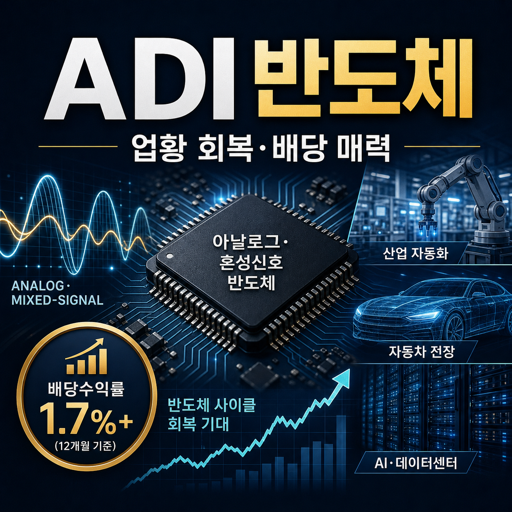
Analog Devices (ADI), the world's leading analog and mixed-signal semiconductor company, demonstrated an earnings rebound by recording revenue of $3.62347 billion in the second quarter of FY2026, driven by a recovery in demand from industrial, automotive, and AI data centers. The current price of $402.69 is close to its 52-week high.
Analysis date 2026-06-02, applied exchange rate 1 USD = 1,503 KRW. All KRW conversions in the text were calculated using this exchange rate.
index
- Key Summary of Analog Devices (ADI) Stock Outlook
- Key terms to know before analysis
- What kind of company is Analog Devices (ADI)?
- Analog Devices Recent Performance Analysis
- Analysis of Analog Devices' Fair Stock Price
- Analog Devices 12-Month Target Price Scenario
- Analog Devices Growth Outlook and Key Drivers
- Key Risks When Investing in Analog Devices
- Analog Devices Investment Opinion Conclusion
- 5 Analog Devices Frequently Asked Questions
Key Summary of Analog Devices (ADI) Stock Outlook
The 12-month baseline target price for Analog Devices is $450 (approximately 676,350 won).
The investment recommendation is Buy.
The key basis is the growth of the industrial sector and the recovery of the analog semiconductor market driven by demand from AI data centers and automobiles.
The current price of $402.69 (approx. 605,243 won) is up about 891 TP3T from the 52-week low of $213.05 and is close to the 52-week high of $435.72.
The expected return based on the baseline target price is approximately +11.71 TP3T, and in a bullish scenario, it is open to $510 (approx. 766,530 KRW).
Key terms to know before analysis
- analog semiconductorsIt is a chip that converts continuous signals from the real world, such as temperature, sound, and pressure, into digital data. ADI's data converter is a representative product.
- Data Converter (ADC/DAC)It is a core component that converts analog signals to digital (ADC) and digital to analog (DAC), and is ADI's largest revenue source.
- Industrial sectorThis is ADI's largest revenue segment, used in factory automation, instrumentation, aerospace and defense, and medical equipment.
- Non-GAAP EPS: Earnings per share excluding one-time expenses such as the amortization of acquired intangible assets. ADI's non-GAAP EPS is significantly higher than its GAAP EPS.
What kind of company is Analog Devices (ADI)?
Analog Devices, Inc. is a semiconductor company headquartered in Wilmington, Massachusetts, USA, founded in 1965.
It holds a world-leading market share across the entire spectrum of analog and mixed-signal semiconductors, including data converters, power management ICs, amplifiers, RF and microwave ICs, and MEMS sensors.
Sales are diversified across industrial, automotive, telecommunications, and consumer markets, resulting in a structure that is less susceptible to fluctuations in specific upstream industries.
As of June 2026, its market capitalization is approximately $196.1 billion (about 294.7 trillion won), making it a leading stock that shares the analog semiconductor market with Texas Instruments.
A powerhouse in the field of AI semiconductor design AI semiconductor design stock ARM Holdings (ARM)Unlike others, ADI is distinguished by having established an unrivaled moat in the analog domain that processes actual physical signals.
Unlike digital logic chips, where competition in microfabrication is key, decades of accumulated design know-how and proven reliability act as barriers to entry for analog semiconductors.
Because customers do not easily replace analog components once adopted, ADI enjoys the strengths of high customer retention and long product lifecycles.
The acquisition of Linear Technology in 2017 and Maxim Integrated in 2021, which significantly strengthened the power management IC portfolio, is also serving as the foundation for the current recovery in performance.
With approximately 24,500 employees and tens of thousands of product lines, it has a decentralized business structure with very low dependence on a single product or single customer.
Analog Devices Recent Performance Analysis
Revenue for the second quarter of FY2026 (ending April 2026) was $3.62347 billion (approximately 5.4461 trillion won).
Net profit for the same quarter was $1.17635 billion (approximately 1.7681 trillion won), more than double the amount from the same period last year.
In particular, the industrial sector surged by 561% year-on-year, driving the rebound in performance driven by demand for AI infrastructure, automation, and defense.
The company signaled a continued recovery by providing revenue guidance of approximately $3.9 billion (approximately 5.8617 trillion won) for the third quarter of FY2026. This ADI Investor Press ReleaseYou can check it at.
| Annual performance (fiscal year) | sales | net profit |
|---|---|---|
| FY2023 | $12.31B (approx. 18.5 trillion won) | $3.31B (approx. 4.98 trillion won) |
| FY2024 | $9.43B (approx. 14.17 trillion won) | $1.64B (approx. 2.46 trillion won) |
| FY2025 | $11.02B (approx. 16.56 trillion won) | $2.27B (approx. 3.41 trillion won) |
It is a typical semiconductor cycle rebound phase where sales and profits recover together starting from FY2025, having passed the low point in FY2024.
With a gross profit margin of approximately 641 TP3T and an operating profit margin of approximately 381 TP3T, it maintains the high profitability characteristic of analog semiconductors.
FY2023 revenue of $12.3 billion was the peak just before the normalization of the supply chain following COVID-19, and subsequently, due to inventory adjustments, revenue decreased to $9.4 billion in FY2024.
Following a rebound in revenue to $11 billion in FY2025, quarterly revenue has trended upward again in FY2026, clearly indicating that the cycle has passed its trough.
Free cash flow is approximately $3.869 billion (about 5.814 trillion won) annually, and the company possesses sufficient cash generation power to cover dividends and share buybacks.
The debt-to-equity ratio (D/E) is low at approximately 261 TP3T, and financial soundness is also good with a current ratio of 1.75 times and a quick ratio of 1.23 times.
The fact that institutional investors hold approximately 93.51 TP3T, providing a solid base of long-term stable shareholders, is also positive in terms of volatility.
Analysis of Analog Devices' Fair Stock Price
ADI's trailing PER on a GAAP basis is high at about 60 times, but its forward PER, excluding the amortization of acquired intangible assets, is about 27 times.
Forward earnings per share (non-GAAP EPS) are estimated at approximately $14.77 (approximately 22,199 won), and with a PEG of approximately 0.91, the valuation is not excessive relative to growth potential.
Applying an average forward P/E ratio of 28 to 32 times during the cycle recovery phase of analog semiconductor peers, the fair value of the stock is calculated to be in the range of $420 to $480 based on a forward EPS of approximately $15.
The average target price of 31 Wall Street institutions is $446, with a median of $450, and recently Evercore ISI raised its target to $474 and Argus to $460.
Memory semiconductor cycle recovery stock Micron (MU), a beneficiary of AI memorySimilarly, the prevailing assessment is that ADI has also entered a multiple revaluation phase after passing the bottom of the market conditions.
Analog Devices vs. Competitor Comparison
ADI's biggest competitor in the analog semiconductor market is Texas Instruments (TXN), and the two companies effectively divide the market.
While Texas Instruments has strengths in cost competitiveness through standard analog mass production and its own 300mm fab, ADI's differentiators are high-performance, high-precision products and a strong presence in the industrial and telecommunications sectors.
Compared to AI semiconductor stocks with high direct exposure to AI, such as Broadcom (AVGO) or Marvell (MRVL), ADI has low volatility but a strong defensive character based on stable demand across the industry.
Unlike Micron (MU), which is driven by memory price cycles, ADI has a higher proportion of specification-based products with low price volatility, making its earnings predictable.
Analog Devices 12-Month Target Price Scenario
| scenario | Target price | Expected rate of return | premise |
|---|---|---|---|
| stress | $510 (approx. 766,530 won) | Approx. +26.6% | Simultaneous Recovery of Industry and Automotive Accelerates Demand for AI Data Center Power Management |
| basic | $450 (approx. 676,350 won) | Approx. +11.7% | Gradual cycle recovery, consensus EPS achieved |
| Weakness | $340 (approx. 511,020 won) | Approx. -15.6% | Slowing forward demand, multiple reduction |
The base scenario target price of $450 (approx. 676,350 won) is calculated by applying a P/E ratio of 30 to the forward EPS of approximately $15.
If the three scenarios are weighted as bullish 30%, standard 50%, and bearish 20%, the expected return is approximately +10%, which is a range with good risk-to-reward.
Analog Devices Growth Outlook and Key Drivers
First, the demand for high-efficiency power management ICs and precision data converters is structurally increasing due to the rising power density of AI data centers.
Second, the amount of analog semiconductors installed per vehicle is continuously increasing due to the spread of automotive electrification and autonomous driving.
Third, factory automation and increased investment in defense and aerospace support the recovery of the industrial sector.
The industrial sector accounts for the largest share of ADI's revenue and, due to its high margins, a recovery in this segment directly leads to improved profitability for the entire company.
ADI's high-value industrial applications, such as medical devices, measurement and testing equipment, and avionics, generate structural demand independent of economic cycles.
As power supply and thermal management for GPU racks emerge as key challenges in AI data centers, demand for ADI's high-efficiency power ICs and precision sensing solutions is increasing.
The 5-year EPS growth forecast presented by Wall Street is approximately 29.651 TP3T, and beneficiaries of AI ASIC design AI ASIC beneficiary Broadcom (AVGO)Ina AI networking semiconductor Marvell (MRVL) It is a solid level even when compared to other high-growth semiconductor stocks. Recent earnings and analyst upgrades are Yahoo Finance reports upward target priceIt is also confirmed in...
Key Risks When Investing in Analog Devices
As the stock price has risen by approximately 841 TP3T over the past year and is approaching its 52-week high, there is short-term valuation pressure.
Analog semiconductors are sensitive to the economic conditions of downstream industries, so if industrial and automotive demand slows down again, the recovery in earnings could be halted.
A trailing PER of 60x on a GAAP basis carries the risk of multiple reduction, so stock price volatility could increase if the consensus EPS is not met.
AI GPU leading stock AI GPU leader NVIDIA (NVDA) Given the low direct exposure to AI, the possibility of relative neglect should be kept in mind when the AI theme is adjusted.
Dependence on the Chinese market and tightening semiconductor regulations between the U.S. and China are also variables that could affect revenue in the telecommunications and industrial sectors.
Exchange rate fluctuations are also a factor affecting ADI's performance in Korean Won, given its high proportion of overseas sales.
Analog Devices Investment Opinion Conclusion
The investment recommendation for Analog Devices is Buy.
The 12-month baseline target price is $450 (approx. 676,350 KRW), suggesting an upside potential of approximately +11.71 TP3T from the current price.
Structural momentum, such as growth in the industrial sector and the recovery of demand for automotive and AI data centers, is supporting earnings.
However, considering the valuation burden due to the short-term surge, a strategy of approaching new entry with staggered buying is reasonable.
An annual dividend yield of 1.091 TP3T and stable free cash flow are downside support factors for long-term investors.
With 28 out of 31 Wall Street institutions issuing buy or strong buy recommendations, the market consensus is also favorable toward ADI's cycle recovery story.
In conclusion, ADI is evaluated as a high-quality semiconductor stock that offers broad coverage of the recovery in industrial, automotive, and AI infrastructure for investors capable of tolerating short-term volatility.
5 Analog Devices Frequently Asked Questions
Q1. What is the 12-month target price for Analog Devices (ADI)?
Based on the base scenario, the level is $450 (approx. 676,350 KRW), with a bullish range of $510 (approx. 766,530 KRW) and a bearish range of $340 (approx. 511,020 KRW). The expected return based on the base is approximately +11.71 TP3T, placing it in the Buy zone.
Q2. How were Analog Devices' recent performance results?
Revenue for the second quarter of FY2026 was $3.62347 billion (approx. 5.4461 trillion KRW) and net income was $1.17635 billion (approx. 1.7681 trillion KRW), more than doubling year-over-year. The industrial sector drove the rebound in performance with a sharp increase of 56%.
Q3. Is ADI's stock price currently expensive?
The GAAP trailing P/E ratio is high at approximately 60x, but the forward P/E ratio is about 27x. With a PEG of around 0.91, the valuation is not excessive considering the growth potential, but there is short-term pressure as the stock approaches its 52-week high.
Q4. What are the core growth drivers of Analog Devices?
The three main drivers are demand for power management and data converters in AI data centers, increased chip loads due to automotive electrification, and expanded investment in factory automation and defense. Wall Street projects a 5-year EPS growth rate of approximately 29.651 TP3T.
Q5. What is the ADI dividend?
The annual dividend is $4.40 per share (approximately 6,613 KRW), with a dividend yield of approximately 1.091 TP3T. An attractive factor is the company's history of consistently increasing dividends based on stable cash flow.
This content is for informational purposes only and does not constitute an investment solicitation. All investment decisions and responsibilities rest solely with the investor.
Sources
- Analog Devices Investor Press Release
- Yahoo Finance — Reports of ADI Target Price Upgrade
- Yahoo Finance — Raymond James raises target price
※ This content is based on publicly available data, written with the help of AI tools, and reviewed by the author. It is for informational purposes only and is not an investment recommendation.